

Quality of life in rural areas at risk
Europe is at a turning point: the total population of the EU has been growing for decades, reaching around 450 million in 2025. According to EU projections, this growth is expected to peak around 2029 – after which the population is projected to gradually decline. The forecast trends vary greatly from one place to another. Nevertheless, the population of the entire European continent is expected to shrink as migration will no longer be able to compensate for the long-declining birth rates.
A recent forecast by the German Economic Institute (IW) reaches a similar conclusion. Germany’s population is likely to start shrinking earlier than previously anticipated, largely due to lower-than-expected immigration.
Leo van Wissen, demographic researcher at the Netherlands Interdisciplinary Demographic Institute, highlights the different pace of demographic change across European countries and regions. He expects that “especially regional differences within countries will intensify, with strong growth in urban areas while rural areas continue to dwindle.”

Bitte nehmen Sie sich einen Moment Zeit.
Nachrichten und Recherchen sind unerlässlich, damit Sie sich eine Meinung bilden können. Aber die derzeitigen Bedrohungen der freien Presse und der Medienlandschaft sind alarmierend.
Wir fordern die Bundesregierung auf, Pressefreiheit und die Medienvielfalt in Deutschland umfangreich zu schützen. Machen Sie mit.
As a result, it is becoming increasingly difficult and costly to maintain services in sparsely populated rural areas. Railway stations, schools, bank branches and bakeries are closing due to a lack of customers and staff shortages. This, in turn, threatens to reduce quality of life for people living in the countryside.
“The ageing of European societies is the greatest challenge,” demographer Claudia Neu tells CORRECTIV.Europe. “We are facing enormous healthcare and long-term care costs, which will likely have to be borne by the younger generation.”

Without immigration, EU population would already be shrinking
The JRC categorises the prospects of the member states into three groups.
Western and Northern Europe are benefiting from migration from outside the EU and from other EU member states.
In southern Europe, Italy and Spain are attracting non-EU migrants but are simultaneously experiencing some emigration to other EU countries as well as extremely low birth rates of around 1.3 births per woman, whereby their populations are expected to shrink in the long term.
Eastern Europe faces a triple demographic threat: low birth rates, ageing populations and significant emigration to Western Europe. Although these countries are gaining some population due to immigration from non-EU countries, these gains are not sufficient to compensate for their losses.
Without immigration, the total population of the EU would already have been shrinking since 2012. Experts interviewed by CORRECTIV.Europe agree that insufficient immigration poses a risk to the economy. A study by the Centre for European Reform reaches the same conclusion.
However, unlike asylum policy, there is no common EU approach to labour migration. Instead, there is a patchwork of around 300 different regulations across member states.
Even right-leaning governments are now developing targeted recruitment programmes for selected migrants. Italy, for example, plans to recruit 10,000 care workers from India.
Efforts to raise birth rates
Concerns about ageing and declining populations have triggered intense debate about birth rates in many countries.
France, for example, plans to send letters to all 29-year-olds encouraging them to think about starting a family at an early stage.
In Hungary, families receive special loans and financial support if they have multiple children within a certain timeframe.
Albert Esteve, Director of the Spanish Center for Demographic Studies, also sees challenges for democracy in the population trend: He poses a poignant question: „If a mayor is faced with the choice of providing money for free childcare, would his decision be influenced by the fact that most of the mothers are foreigners without voting rights?“
What the data shows
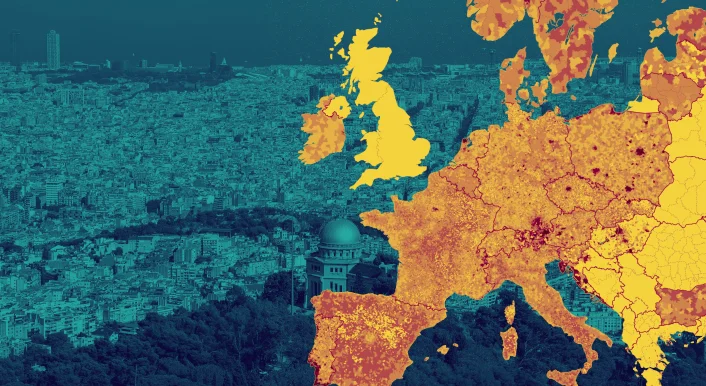
This dataset contains the total number of residents in every EU municipality (as well as Norway, Switzerland, Liechtenstein, Iceland, and the UK) at 10-year intervals from 1961 to 2024 (Except the UK and Iceland only until 2021). All figures are expressed in terms of modern municipal boundaries. This means we can compare 1961 to 2024 without worrying about the fact that many towns have merged, split, or been redrawn over the decades.
This data is unique in this form, as municipal borders change constantly. A village that was independent in 1961 may have been absorbed into a larger city by 2024. If we simply used recorded historical population figures, we would be comparing apples to oranges.
The methodology
The JRC researchers have taken all historical population data and recalculated it as if today’s borders had always existed.
For 2024, the actual census counts at current municipal borders were already available, so no recalculation was needed. For all earlier decades (1961–2011), the researchers used a technique called dasymetric mapping. Here is the intuition:
1. Started with historical population figures recorded at the old borders (for example, a historical district from 1971).
2. Overlaid today’s municipal borders on those old boundaries.
3. Use building volume as a proxy to decide how to split the population between zones. The assumption is: more residential buildings equals more people. They used satellite-derived data on residential building volume (from the EU’s Global Human Settlement Layer) to estimate where people actually lived within each old territorial unit.
4. Redistributed the population proportionally across today’s boundaries based on that building volume.
5. For all reference years, including 2024, cross-checked totals against population figures from the Annual Regional Database of the European Commission’s Directorate-General for Regional and Urban Policy (ARDECO) and rescaled them so that everything adds up consistently at the regional level.
Data sources
Population figures came from CensusHub, Eurostat’s harmonised platform for European census data, and from a historical population data collection. Building volume data came from satellite imagery.
Caveats and limitations
The method assumes that where there are more residential buildings, there are more people. This is usually true, but not always.
Historical census data have their own errors and gaps, which carry through into the final figures.
The recalculation introduces additional estimation uncertainty, especially for smaller municipalities and earlier decades, where source data is coarser.
The data is highly reliable for showing broad trends (regional growth, rural decline), but individual small-municipality figures (especially for 1961 and 1971) should be treated with more caution.
When citing the data findings, it’s important to state ‘according to data from JRC’, as the exact numbers might differ (even if slightly) from other sources
The definition of “rural” in the dataset is density-based (EU definition) and it might clash with other definitions. For example: the population of French rural municipalities are growing in our dataset, but according to the World Bank data the population is shrinking.
Text and research: Lilith Grull, Frida Thurm
Data and visualisation: Ada Homolova, Luc Martinon
Web development: Philipp Waack
Design: Max Bornmann, Mostafa Negm
Editing: Justus von Daniels, Marius Münstermann
Factchecking: Johannes Gille, Marius Münstermann, Philipp Waack

