
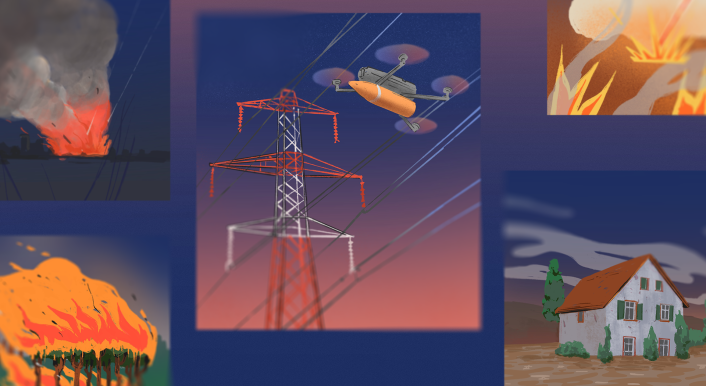
Many counties and independent cities in Germany are inadequately prepared for crises, according to a nationwide questionnaire prepared by CORRECTIV. The findings show that 106 local authorities have already implemented the measures set out by them in a crisis response plan. A further 97 have drawn up such a plan but have yet to implement it. 38 local authorities said they had no specific plan in place, while for the remaining 160 it was unclear whether one existed. Such plans are intended to govern preparedness and cooperation between public authorities in crises such as flooding, power cuts and threats arising from war.
Flooding, power cuts and blackouts pose challenges
In total, 266 of the 401 surveyed counties and independent cities submitted substantive responses. Just over three-quarters of these answered questions about the consequences of climate change. Most expect climate change to intensify extreme weather events in future, driving up costs. Heavy rainfall, storms, heatwaves, catastrophic flooding and droughts are seen as particular risks.
At the same time, local authorities acknowledge that more needs to be done to prepare for sabotage and widespread power cuts. Such events can bring mobile phone networks, transport and essential supplies to a standstill. Among the shortcomings identified are a lack of resilient infrastructure and clearly defined arrangements for emergency power supplies – both of which are critical for hospitals, care homes and emergency services during a crisis.

Bitte nehmen Sie sich einen Moment Zeit.
Nachrichten und Recherchen sind unerlässlich, damit Sie sich eine Meinung bilden können. Aber die derzeitigen Bedrohungen der freien Presse und der Medienlandschaft sind alarmierend.
Wir fordern die Bundesregierung auf, Pressefreiheit und die Medienvielfalt in Deutschland umfangreich zu schützen. Machen Sie mit.
Personnel and funding remain bottlenecks
Alongside technical equipment, many local authorities also point to personnel shortages and inadequate staffing structures. A total of 137 counties and independent cities said they had secured adequate volunteer staffing, while 65 said provision was only partly secured and 20 said the situation remained unresolved. Civil protection relies on volunteers, who may be needed in several places at once when multiple crises occur simultaneously.
“Can a local authority really cope with an emergency on this scale using its own resources alone? The answer cannot depend on chance or luck,” says Darius Ansani, a volunteer deputy chief of the municipal fire brigade in the Rheingau-Taunus district.



Among the counties and independent cities that took part in CORRECTIV’s questionnaire, 48 said they could fully fund the measures required. A further 93 expected only to be able to fund them partially, while 50 said they were unlikely to be able to finance the measures at all. The remaining authorities did not provide information.
Effective cooperation and communication are crucial – including with the public. “Civilians need to do more to prepare themselves,” says Dennis Wolf. No one should expect that, during a power cut, “someone will turn up within 15 minutes to switch the lights back on or bring food”. Those who can initially help themselves ease the burden on emergency responders, allowing them to focus on people in urgent need of assistance.
Major gaps in protective shelters
At least 180 counties and independent cities say they have no officially designated protective shelters or do not know whether any exist.
According to the Federal Office of Civil Protection and Disaster Assistance, of the approximately 2,000 public shelters that originally existed, just 579 – with space for around 478,000 people – remain formally designated for civil protection. They are not currently operation.
“We are already facing several crises,” says Jannik Hartmann, an associate fellow at the NATO Defense College. In addition to the war in Europe, he points to acts of sabotage in Germany as well as heatwaves and severe storms.
It is scarcely possible to provide complete protection against every crisis. What matters is how well local authorities and the public are able to act when an emergency strikes. The CORRECTIV investigation shows that the level of protection available to people also depends on where they live.
German County Association sees CORRECTIV findings as serious warning
The German County Association has described the findings of CORRECTIV’s questionnaire as “a serious warning signal”. They underline the urgent need to strengthen financial and staffing capacities in the area of civil protection”.
The counties were fulfilling their responsibilities and had at their disposal experienced emergency personnel as well as crisis management teams and established emergency response structures. At the same time, demands were growing. These challenges could not be met in the long term with staff who were already overstretched and inadequate budgetary resources.
The association also urged caution in interpreting the survey results. Since only around two-thirds of the counties contacted had provided substantive responses, it said, the findings could not provide a conclusive picture.
Text and research: Lilith Grull, Johannes Gille, Katarina Huth, Frida Thurm, Till Eckert
Data work: Johannes Gille, Lilith Grull, Katarina Huth, Marius Münstermann, Carolin Lewandowska, Philipp Waak, Benjamin Werner
Editing: Justus von Daniels, Stella Hesch
Fact-checking: Stella Hesch, Rose Mintzer-Sweeney
Design: Mohamed Anwar
Communication: Anna-Maria Wagner, Alicia Reusche


