
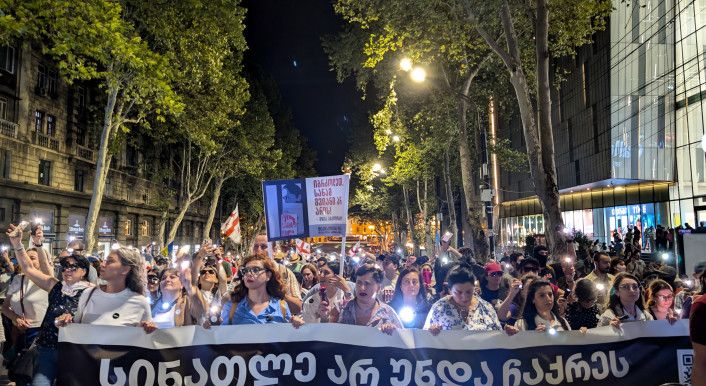
One morning on the Sinatle Network bank account we received a transfer. Its purpose of payment says: “In support of media freedom” — from Mzia Amaglobeli, Women’s Prison No. 5.
In January 2025, Sakharov prize winner Mzia Amaglobeli was first detained on an administrative charge for placing a sticker calling for a general strike on an auxiliary wall of a police office. She was released from administrative detention a few hours later and joined other protesters in a peaceful demonstration. Soon after, police began detaining participants without grounds. During the physical confrontation and crush between police and protesters, Mzia Amaglobeli fell to the ground and sustained injuries to her limbs.
During her unlawful administrative detention, Mzia witnessed inhumane treatment and abuse against other people at the police station. After having been injured in a physical confrontation with police, she slapped the then-police chief, Irakli Dgebuadze, which led to her arrest on criminal charges. During her second detention, police chief Dgebuadze spat in her face and mistreated her; however, no effective investigation has been carried out by the Prosecutor’s Office.
During the court hearing, she said: “It is for you to decide what to call it: an attack, or the impulsive reaction of a humiliated, insulted person” . She was initially charged with “attacking” a police officer, an offense carrying a minimum sentence of four years in prison, but the court later requalified the charge to “resistance, threat or violence” and sentenced her to two years.
I repeatedly went over the text message in the payment reference several times, and I was so stunned I couldn’t believe my eyes. I immediately shared it with my colleagues in our group chat. None of the journalists, not even the lawyers, knew that a prisoner could send a money transfer. In Georgia, prisoners are given prison accounts into which family and friends can deposit money, which they can then spend in the prison shop. We learned that Mzia doesn’t spend this money: she only eats prison food and uses the provided basic supplies . She sent us 1,000 Georgian Lari (EUR 330) that had built up in her account, as a donation to support the Sinatle Network media.
The Georgian Dream, Georgia’s ruling party running, which has embraced an anti-EU rhetoric, thought that Mzia’s punishment would have a chilling effect; however, the exact opposite had happened. We call it “Mzia’s effect” and it shows what journalists can do in an extremely repressive environment. My colleague Nana Kvachadze from Batumelebi, an independent Georgian media platform co-founded by Mzia, recalled, “Mzia arrested late at night and the next day, early morning Batumelebi’s office was full of journalists, traveling from different regions and the capital. It meant that we were not alone in this unequal fight.”
We journalists will always remember police chief Dgebuadze’s court testimony, in which he said “I felt pain” after Mzia Amaglobeli slapped him, an act as a reaction to having seen abuse and humiliation inside the police station. My colleagues often say that Mzia is our conscience: Throughout nine months of court hearings, she never once found herself in the dock. Her honesty and her refusal to be broken gave us the thing we needed most: belief. That is why Mzia has become the symbol of independent media in Georgia.
How we got here
1 October 2026 marked 14 years since the Georgian Dream party came to power. In 2012, billionaire and then prime minister Bidzina Ivanishvili (today’s honorary chairman and still informal leader) promised to protect human rights, build a strong democracy, ensure Euro-Atlantic integration, and promote economic growth.
After Georgian Dream won its third consecutive election in 2020, the democratic backsliding became increasingly evident.
In 2023, Georgia’s ruling party, Georgian Dream, first tried to pass a “foreign agents” law. It withdrew the bill after mass street protests, only to bring it back a year later. Adopted in May 2024, the Law on Transparency of Foreign Influence requires any organization that receives more than 20% of its funding from abroad to register as an “organization pursuing the interests of a foreign power.”
“From the moment the law was proposed, its purpose was clear to us: to impose on Georgia’s media and civil society the same legal environment that exists in Russia and Belarus. Those countries left no doubt about where that leads: the weakening, and eventual elimination, of independent voices,” says Lika Zakashvili, Publika’s founder and editor-in-chief.
Independent journalism has always been underpaid and fragile. In an environment where society is economically vulnerable and businesses operate under heavy political pressure, building a sustainable model for independent journalism is extremely difficult. The only way of funding in this ecosystem is the foreign grants. Georgian media outlets and civil society organizations thus responded by rejecting the law and refusing to register. At first, the penalty for refusing was an administrative fine, and in practice the law went largely unenforced: the authorities took no action against those who refused to register.
Within weeks of the following Georgian Dream party’s victory in the 2024 election, prime minister Irakli Kobakhidze announced that Georgia would suspend its EU accession process until 2028. The decision sparked a massive wave of protests, which led to clashes at demonstrations. Many people were injured –video footage captured special police forces brutally beating peaceful demonstrators and journalists covering the protests– most of those detained were subjected to torture and other ill-treatment. Afterwards around 50 people were charged with criminal offences. Since then, protests in Georgia have continued for more than 719 consecutive days.
The pressure on the media and civil society escalated. The newly formed parliament adopted a Georgian version of the US Foreign Agents Registration Act (FARA), making failure or refusal to register as a “foreign agent” punishable by up to six years in prison for both organizations and individuals. Independent media continued to reject the label. Our work is public-interest journalism, not lobbying, and the government has no right to call us “agents”.
The government then turned to the Law on Grants. An amendment now requires government approval for every foreign grant, and under the most recent changes, receiving a grant without that approval can lead to criminal prosecution. Georgian media lost what it depends on to exist.
For independent media in Georgia, that leaves two options: give up and leave the country, or stay and serve the public. Since 2023, despite everything, not one single Georgian outlet has gone into exile.
Where we are now
None of this has come without cost. Newsrooms have shrunk, offices have been lost, and unemployment in the profession has risen. Journalists have been beaten and abused. Between October 2024 and 2025 600 attacks against the press were documented: including assaults, arbitrary fines, arrests, threats, suspensions of accreditation and more. Recently, journalist Vakho Sanaia was sentenced to 30 days over some social media posts.
We watched the brutal assaults on journalists unfold on live television, when Guram Rogava, Maka Chikhladze and Aleksandre Keshelashvili narrowly escaped death. Posters reading “traitor” were pasted up outside our offices, and our old cars were scrawled with “agent sold for money”.
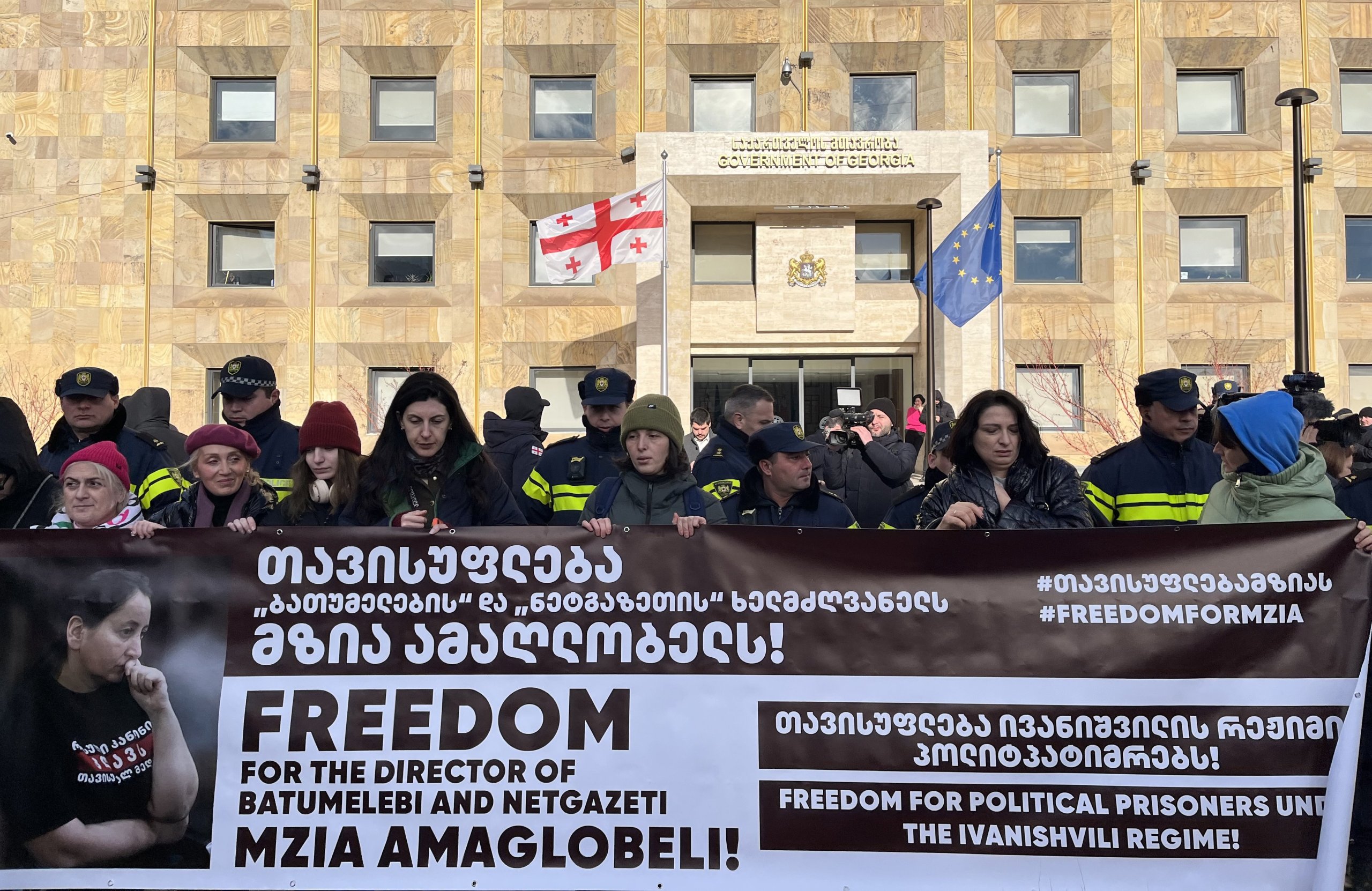
The government’s smear campaigns tried to portray us as a wealthy industry working for foreign interests. It didn’t work. Propaganda needs at least a mustard seed of truth to grow into an avalanche. Here, there was none. I will never forget a comment one of our readers left on Facebook, beneath a photograph of my editor Nino Zuriashvili’s damaged car: “People who’ve sold out for money don’t drive Toyota Prius.”
A story to tell.
In the middle of what seemed like an insurmountable crisis, a spark of unity appeared — of standing together. That is when the Sinatle Media Network (Sinatle meaning “light” in Georgian) was born.
Sinatle Media, a solidarity and sustainability network for independent Georgian online media outlets was founded in mid-August 2025 as a unified response from 22 independent online media organizations. We launched the platform and its first nationwide solidarity campaign, “The Lights Must Stay On”. The campaign began with a symbolic shutdown action, during which the websites of all 22 –out of which 11 are regional media outlets– independent media outlets were temporarily taken offline, accompanied by a joint video message simultaneously published across the social media platforms of all the outlets. We wanted to show what Georgia risks losing if independent journalism disappears – and to mobilize society, the business sector, and international partners to defend free media at this critical moment.
In the very first weeks of the campaign, people showed remarkable solidarity. And when it came time to share the funds among 22, every Tbilisi-based outlet chose to give up its share to small regional media outlets, as they were more vulnerable and insecure at that moment. This act defined the future of this network. We chose collaboration over competition. “Without Sinatle Media, Chemi Kharagauli would not have been able to survive. This network of independent media outlets strengthens us morally, psychologically and financially” – says the founder of the regional small media outlet Laura Gogoladze. Within Sinatle, we got to know one another far more closely. We combined our individual strengths and faced our challenges together. Without this network, many small regional outlets, each a main source of light in its community, would no longer exist.
OC Media, a member of our network, always gives its share of donations to regional outlets through Sinatle. Its co-founder Mariam Nikuradze says: “For me, the existence of Sinatle Media is above all an illustration of how much resilience the media has shown in a repressive environment and, most importantly, of the unprecedented solidarity that has emerged among us. Sinatle creates the feeling that we are not alone, and that we will not abandon one another in hard times. Our readers showed us this too, by standing with the media.”
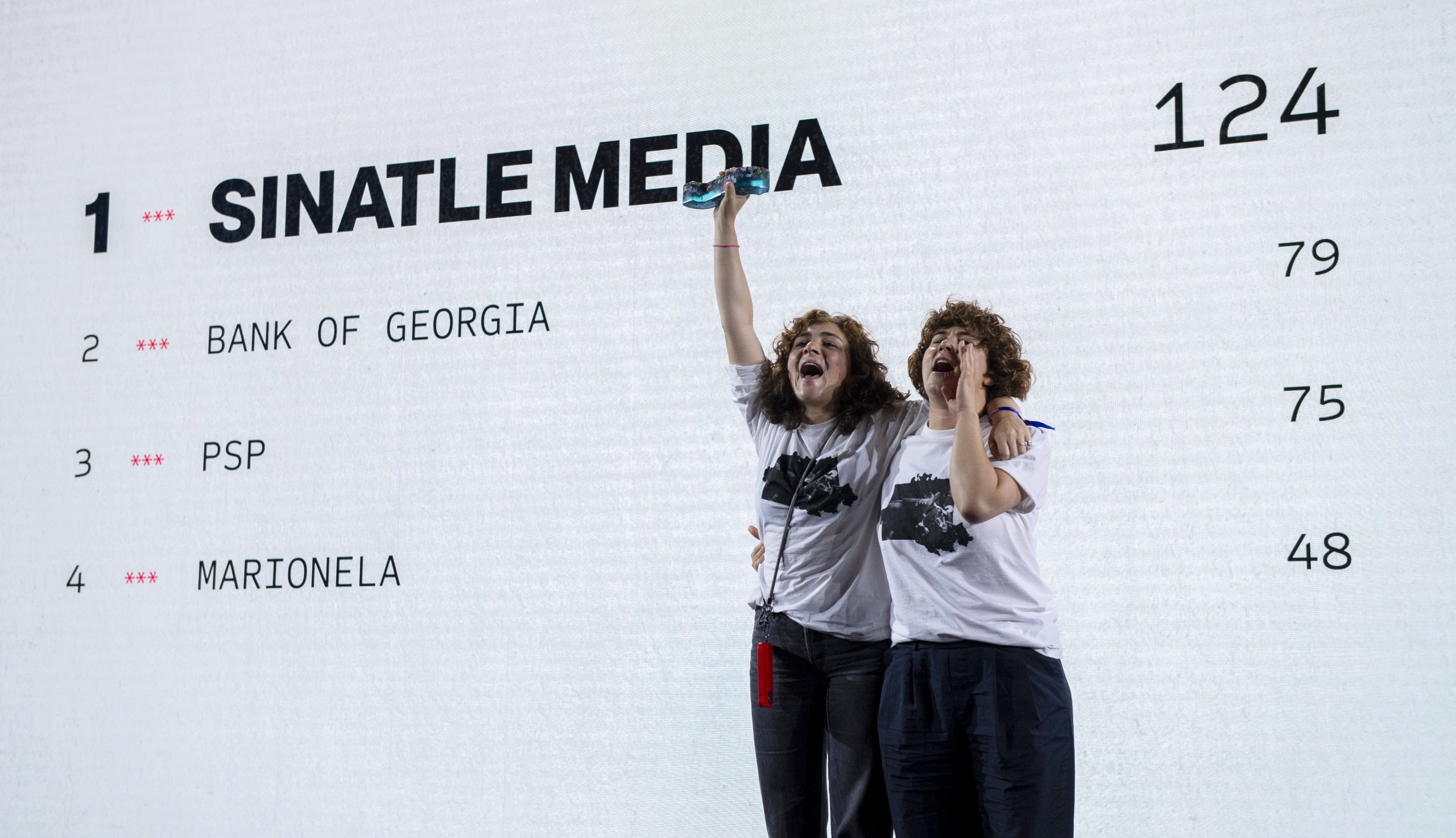
After this campaign, a wave of solidarity began inside and outside Georgia. Emigrants organized events in London, New York, and Berlin, people were selling their belongings on Facebook and even asking for donations as their birthday wish.
For the auction organized by Sinatle, artists donated their work, while writers, actors and directors brought out family heirlooms from their homes. Mountaineers donated edelweiss they had brought back from the Pamir Mountains. And Zviad Ratiani, a prisoner of conscience and a renowned Georgian poet and translator, sent one of his manuscripts from prison to help support the media. At the spring and Christmas flea markets, under the slogan “Buy and Sell for Sinatle”, the atmosphere was like a fairy tale. People of all generations and professions came together: teenagers sold their vinyl record collections, while parents sold homemade traditional Georgian sweets.
Far more supporters came to these events than any of us had expected. I will never forget the journalists’ faces lighting up. It was at these offline gatherings that they discovered how many people stand behind their relentless fight. Events like these have built bridges between media outlets and their communities: people who are ready to take the streets in solidarity with independent media.
Investigative journalist and founder of Monitor Nino Zuriashvili says: “When the flea market began, people came and brought things to sell — their own art belongings, paintings, valuables, family heirlooms. And in doing so they were telling us: ‘Our country needs you. Don’t you dare stop, you have to keep going.’
To date, Sinatle has raised GEL 330,000 (EUR 100,000) — in a country where one of five children lives in extreme poverty. Divided among 22 outlets, it is not a large sum, but it has allowed us to save things that matter. Most news offices stayed open. Journalists could pay for transport to go out and cover stories. Internet and heating bills were paid. And in some regions, we even managed to bring journalists back into newsrooms — reporters who had been working as tour guides and teachers to support themselves.
“It used to be that even our training sessions were held separately: one for regional media, another for the outlets in the capital. Today Sinatle is a network that knows no territorial borders”, Kamila Mamedova, Radio Marneuli’s founder and editor-in-chief says.
In his book “On Tyranny”, U.S. American historian Timothy Snyder speaks about how vital it is to defend institutions while they are violently attacked by the authorities. In the last decade democracy has declined around the world and institutions have been undermined. That is why in his “second lesson” he urges “Do not speak of ‘our institutions’ unless you make them yours by acting on their behalf… So choose an institution you care about – a court, a newspaper, a law, a labor union – and take its side.”
Sinatle has brought together supporters who are ready to defend independent online media: Not only through donations, but also by sharing their knowledge and skills. Even our CEO, a business-sector professional, works for us pro bono. Beyond crowdfunding and community building, these professionals are now helping us develop commercial products within Sinatle, which we hope will become a sustainable source of income for the media in the future.
Georgia’s media ecosystem was once fragmented, with outlets seeing one another only as competitors. The crisis and a common enemy have united them to such an extent that they began sharing the proceeds of nationwide fundraising campaigns equally. Alongside public support, it is precisely this solidarity within the industry that keeps Georgian media alive today. Joining forces is what has made it possible for journalists to stay in the country, keep working in the field, and serve the public.
How to stay informed
For readers who want to follow Georgia beyond the headlines, these English-language sources are a good place to start:
- Sinatle Newsletter – We’re launching a joint monthly newsletter featuring the best stories from 22 independent Georgian media outlets. Reaching audiences outside Georgia was one of the network’s main goals, and within a year its members launched the newsletter together. “Our mission is to look beyond the daily, routine flow of news and create a different line of events”, says its editor, Tamar Babuadze. Leave your email address below to receive the newsletter and be one of its first readers and support our network [link]
- OC Media – An independent English-language news organisation. It produces fact-checked, in-depth reporting on politics, human rights, conflict, and social justice across Georgia, Armenia, Azerbaijan, and the North Caucasus. [link]

