

CORRECTIV weiterentwickeln – mit Ihrer Hilfe
Welche Themen, Formate und Angebote sind Ihnen wichtig?
Mit unserer Umfrage möchten wir besser verstehen, wie wir CORRECTIV für die Zukunft aufstellen können. Die Umfrage dauert nur 5 Minuten.
Learning to Backslide: How Autocrats Share Money, Methods, and Models
Democracy is not dying by sudden coup – it is being dismantled through the law itself, using a shared playbook refined across continents.

This special series draws on CORRECTIV.Exile’s network of journalists and professionals remains under pressure to document how authoritarian leaders are learning from one another and accelerating democratic backsliding worldwide. We aim to reveal the patterns: Hungary’s methods replicated in Poland, Russia’s “foreign agent” laws spreading to Georgia and Serbia. This is not an isolated crisis but a coordinated global shift – a warning before legal becomes irreversible, before democracy becomes memory.
It is a mistake to believe that democratic backsliding is a national problem, or that it merely involves isolated political friendships. In Europe, a resilient network has long existed that secures authoritarian power—supported by documented financial flows and formal partnerships. This network operates through state treaties, diplomatic channels, cooperation agreements, party foundations, and think tanks. It is documented in court records, leaked emails, and intelligence reports. Its goal: mutual political survival.
The Authoritarian Axis: Why They Network
In October 2024, North Korea deployed combat troops to support Russia’s war in Ukraine—the first such deployment since the Korean War. By July 2025, Ukrainian intelligence estimated 30,000 North Korean soldiers fighting alongside Russian forces, with North Korea providing an estimated 5 million artillery shells and ballistic missiles. In exchange, Russia provides cash, combat experience, and satellite technology.
Three months later – after North Korea deployed combat troops to support Russia´s war -, Presidents Putin and Pezeshkian signed a 20-year Russia-Iran strategic partnership. The deal has 47 articles covering defense, cybersecurity, intelligence sharing, and nuclear cooperation. The deal was signed precisely three days before Donald Trump’s inauguration, a deliberate timing to signal resilience regardless of changes in American leadership.
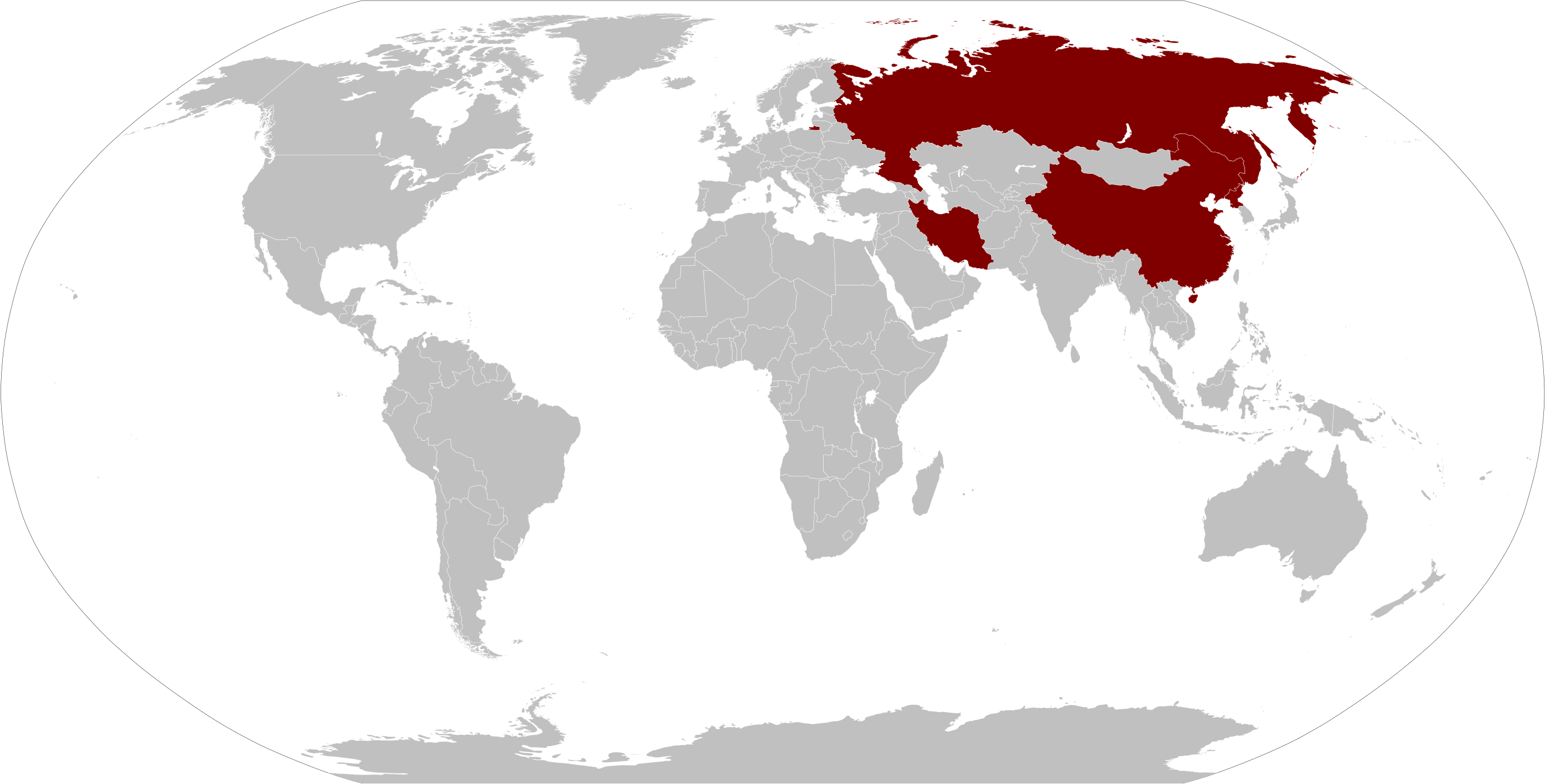
The CRINK axis—China, Russia, Iran, North Korea—now operates through formal alliances, joint military exercises, mutual UN veto protection, and institutional coordination. These are not mere diplomatic relationships. They represent a parallel international order with its own rules and financing mechanisms. The purpose: mutual protection, resource sharing, and coordinated resistance to democratic pressure. China provides economic leverage through infrastructure investments (like Hungary’s Budapest-Belgrade Railway with its 2,400-year payback period), Russia offers direct financial support and military technology, and together they create dependencies that translate into political vetoes—as when Greece and Hungary blocked EU statements criticizing China.
Budapest: Where East Meets West
At the center of this European network stands Hungary under the leadership of Viktor Orbán. Since 2010, the country has developed into what scholars describe as a laboratory of illiberalism—a testing ground where techniques are tried out, refined, and then adopted by governments from Poland to El Salvador, from Israel to Brazil. Hungary’s system is regarded as an example to emulate, as a model of conservative governance and a blueprint for achieving political dominance. The regime serves as a pilot project: a proven model that shows others how power can be consolidated while democratic structures remain outwardly intact. Consequential for Western democracies is the extent to which this authoritarian network connects to domestic political movements. An important convergence point is Budapest.
The CPAC (Conservative Political Action Conference) gathering in Hungary has become the signature event at which autocrats meet Western right-wing leaders. Held annually since 2022 and organized by the Hungarian government-funded Center for Fundamental Rights, it now attracts sitting prime ministers from Hungary, Slovakia, and Georgia, as well as leaders of Germany’s AfD and other European right-wing politicians. At May 2025’s gathering—self-billed as the “largest gathering of patriots ever”—Viktor Orbán offered his “recipe” for implementing right-wing governance: “No migration, no gender, no war.”

AfD co-chair Alice Weidel made her first appearance that year after not being invited to previous years, calling Orbán “the true beacon of freedom” and praising Hungary as a model for AfD’s opposition to immigration and the EU.
Orbán, Heritage, and Trump: A Strategic Partnership
The networking serves a clear purpose: sharing a working model.
The Heritage Foundation President, Kevin Roberts, called Orbán’s Hungary “the model for conservative statecraft” and was awarded the Hungarian government’s Officer’s Cross of the Order of Merit. Project 2025, the Heritage-led transition blueprint, carries these lessons directly into American policy. In May 2024, Project 2025 was presented in Budapest, and by March 2025, 42% of its goals had been implemented during Trump’s second term.
CPAC’s global expansion creates regular meeting grounds for this coordination. Beyond Hungary, international CPACs now operate in Brazil, Japan, Australia, Mexico, Argentina, and Poland.
Lobbying in Brussels: How the MCC brings Hungarian influence to the EU capital.
The Russian historian and human rights defender Sergey Lukashevskiy observes the network’s display particularly in shared ideological values. “In the end, it is a community of like-minded people.” The network’s purpose is to accelerate implementation by learning from one another’s successes and failures.
Networking and influence do not stop at conferences — they extend to lobbying efforts, particularly in Brussels. A key example is the Mathias Corvinus Collegium (MCC), which is officially described as an independent think tank. In reality, it is heavily funded by the Hungarian state. With its Brussels office operating on a €6.3 million budget, MCC has become the second-largest political think tank in Brussels.
The organization’s connections reach deep into the conservative American political sphere. This became especially visible in August 2021, when political commentator Tucker Carlson broadcast from Budapest for an entire week. The arrangement was brokered by American conservative Rod Dreher, who receives $105,000 annually from the Hungarian government-funded Danube Institute. Carlson, who had also gained attention as the first Western commentator to interview Vladimir Putin, after the full-scale invasion of Ukraine, significantly boosted Orbán’s profile among American conservatives through this visit.
Hungary is classified as “no longer fully democratic” — the “Hungarian model”
In 2019 V-Dem Institute downgraded Hungary as the first EU member state to “electoral autocracy.” These are systems of government that still hold elections, but no longer meet democratic standards. The democratic rituals primarily serve to legitimize authoritarian power. In September 2022, the European Parliament declared Hungary ‘no longer a full democracy’ by an overwhelming vote of 433 in favor, 123 against, and 28 abstentions.
What makes the model attractive to other autocrats is its effectiveness and replicability. The Hungarian model doesn’t begin with tanks or coups—it exploits the very institutions designed to protect democracy. Orbán’s transformation relied on winning a constitutional supermajority through democratic elections in 2010, then using that legitimate electoral mandate to systematically rewrite the rules from within. Constitutional capture precedes judicial manipulation—in 2012, the abrupt lowering of the mandatory retirement age forced out 57 court leaders, creating vacancies filled with loyalists.
Market mechanisms instead of bans: Hungary’s legal paths to media dominance.
Media capture follows the same playbook, using market mechanisms rather than censorship: through favorable regulations and state advertising budgets, independent media are economically strangled while pro-government outlets flourish. This reached its apex on November 28, 2018, when 476 pro-government media outlets were “donated” by oligarchs to the newly created Central European Press and Media Foundation (KESMA), which the government declared a matter of “national strategic importance,” thereby exempting it from antitrust review. Every step appears legal, making resistance difficult and international condemnation easier to dismiss as interference in domestic affairs—autocracy.
Which countries are adopting Hungary’s model
Countries explicitly adopting the Orbán playbook include Poland under PiS (2015-2023), where Kaczyński stated, “Viktor Orbán gave us an example of how we can win.” Poland replicated Orbán’s court-packing and public media takeover. Israel’s 2023 judicial reform closely followed Hungary’s template by stripping the Supreme Court’s review powers and giving the ruling coalition control over judicial appointments.
El Salvador’s Bukele engineered what analysts call “orbanismo tropical,” purging the Constitutional Chamber in 2021 and exploiting gang violence—like Orbán used the migration crisis—to dismantle democratic safeguards while maintaining popular support. The network shares this model because it compresses the timeline—what took Orbán a decade, others can achieve in years.
Beyond Orbán: Autocratic networks from Central Asia to Belarus
But it is not only Orbán that is the impulse generator on the autocratic stage. While Hungary is a model for the deconstruction of parliamentary democracies, there are countries where the period of liberalization was short, with a very fast decline into authoritarian, even totalitarian regimes. For the historian Lukashevskiy, this constitutes a breeding ground for another network observable in Central Asia, in which countries such as Turkmenistan, Uzbekistan, and Kazakhstan exchange methods and begin adopting Russian-style practices regarding autocratic strategies and Russia’s role as the financial supervisor.
Belarus is a special case: “In Russia, we used to say that Belarus`s today is Russia’s tomorrow,” states Lukashevskiy, referring to the methods Putin’s regime is adapting from Lukashenko when it comes to the repressive measures against human rights groups or the classification of media representatives as extremists. While Russia has been providing financial and economic support to Belarus since the mid-1990s, it has also provided military support since 2022. But this relationship is a give-and-take.
Lukashenko initially “sold” his loyalty to Russia when his regime was already more authoritarian, but today he is deeply dependent on Moscow both economically and politically. Despite this, his rule remains even harsher than Russia’s, marked by mass arrests, extreme repression of media consumption, and brutal treatment of political prisoners.
Follow the Money: How the Network Is Financed
The network’s effectiveness depends on financial flows connecting authoritarian states to Western political movements. Two primary pipelines enable this coordination: Russian funding to European far-right parties, and American dark money flowing through conservative foundations.
Russian Money to European Far-Right
The financial connections between Russia and European far-right parties reveal why autocrats invest in these networks: they buy influence and destabilize democratic unity.
Marine Le Pen’s National Rally received a €9.4 million loan from First Czech-Russian Bank in September 2014—a bank whose owner had previously worked for a billionaire in Putin’s inner circle. Le Pen met with Putin in person at the Kremlin in March 2017, just before the French presidential election.
In Austria, the May 2019 “Ibiza Affair” exposed Vice-Chancellor Heinz-Christian Strache discussing with a woman posing as a Russian oligarch’s niece how to secure control over Austrian media and state contracts. He expressed a desire to create “a media landscape like Orbán did” and mentioned meetings with “Putin advisers.” The government collapsed within 48 hours. What the video revealed as an aspiration had already been formalized: in December 2016, the FPÖ had signed a five-year cooperation agreement with Putin’s United Russia party.
Italy’s Lega party negotiations were captured on audio recordings at Moscow’s Metropol Hotel in October 2018, in which participants discussed channeling €65 million to the party. Germany’s AfD faces investigations following the Voice of Europe scandal, in which Czech intelligence exposed payments of up to €1 million per month to European far-right politicians via cash and cryptocurrency. The Voice of Europe scandal was part of a broader Russian influence operation targeting European politics.
The Atlantic Pipeline
US conservative foundations have invested at least $50 million of documented “dark money” in Europe over the past decade. The purpose: fund parallel institutions that can operate outside democratic accountability.
Alliance Defending Freedom (ADF) is the primary U.S. legal organization active in Europe, with annual European expenditures of $4.7 million. ADF served as institutional patron at the 2012 founding conference of Poland’s Ordo Iuris, which drafted Poland’s near-total abortion ban and helped establish “LGBT-free zones” covering one-third of the country.
The Infrastructure: How Money Moves Invisibly
The mechanisms enabling cross-border authoritarian financing have grown sophisticated enough to constitute parallel financial infrastructure. Shell companies, donor-advised funds and cryptocurrency networks create layered anonymity that defies traditional regulatory oversight.
“Unfortunately, these authoritarian and right conservative guys were successful in copying the liberal system of supporting civil society. In the end they are uncivil civil societies.” says Lukashevskiy.
Real estate laundering operates at massive scale. More than 20% of nearly $9 billion in UK property value shows associations with potential money laundering connected to the Kremlin. Russian oligarchs Boris and Arkady Rotenberg evaded 2014 sanctions through corporate restructurings, villa transfers to shell companies, and “closed mutual funds” that obscure ownership.
The Voice of Europe scandal revealed how cash and crypto payments reach individual politicians. Czech intelligence documented the Prague-based propaganda network funneling up to €1 million per month to far-right politicians in Germany, France, Poland, Belgium, the Netherlands, and Hungary. Payments were made in cash during Prague meetings or via cryptocurrency. Polish searches seized €48,500 and $36,000 in cash connected to the operation. Putin’s confidant, Viktor Medvedchuk, was identified as a key figure in the network.
These financial flows create dependencies that translate into political outcomes: blocking EU sanctions, vetoing critical statements, weakening NATO cohesion, and providing diplomatic cover for authoritarian actions. The money doesn’t just buy influence—it builds the infrastructure for coordinated democratic backsliding.
Conclusion: The Network’s Purpose Is Clear
The authoritarian international is not a conspiracy theory. The architecture is documented in bank records, video evidence, signed cooperation agreements, and intelligence reports. Russian loans to Le Pen, Austrian vice-chancellors discussing oligarch investments on hidden cameras, audio recordings of oil deals in Moscow hotels—the evidence is extensive and specific.
What emerges is a network operating at multiple levels: state-to-state alliances formalized through treaties; ideological infrastructure connecting movements through conferences; direct financial flows from authoritarian states to Western parties; and dark-money conduits enabling anonymous transfers. These levels reinforce each other because the network’s ultimate purpose is mutual survival. When we look at the post-Soviet autocrats Sergey Lukashevskiy draws clear connections: “On the one hand, every dictator or authoritarian leader is looking at each other and copying practices. And on the other hand, this wave of new fascist ideology from Western Europe was adapted to the local situation by leaders like Orbán, Putin, and others.“
– – – – – – – – – – – – – – – – – – –
Redigatur: Samira Joy Frauwallner
Grafiken: Titelbild – Viera Zuborova
Kommunikation und Social Media: Katharina Roche