

In this article series, we take a second look at current events in countries that often remain only briefly spotlighted in German reporting. Together with local experts, we ask: What political and social developments lie behind the current events that we see in the news? What does this mean for democracy and media freedom? With our exile expertise, we want to reveal global connections and understand what we can learn from this for free, democratic coexistence.
Introduction: What you think you know about eastern Ukraine
What do you think of when you hear the phrase ‘Russian-speaking eastern Ukraine’?”
Bitte nehmen Sie sich einen Moment Zeit.
Nachrichten und Recherchen sind unerlässlich, damit Sie sich eine Meinung bilden können. Aber die derzeitigen Bedrohungen der freien Presse und der Medienlandschaft sind alarmierend.
Wir fordern die Bundesregierung auf, Pressefreiheit und die Medienvielfalt in Deutschland umfangreich zu schützen. Machen Sie mit.
If you have been following the war through the lens of Russian state media — or even through the way many Western outlets have, for years, reflexively balanced ‘both sides’ — you probably think of a region that always felt more Russian than Ukrainian. A region where people wanted to join Russia, voted to join Russia, and welcomed Russian forces when they arrived.
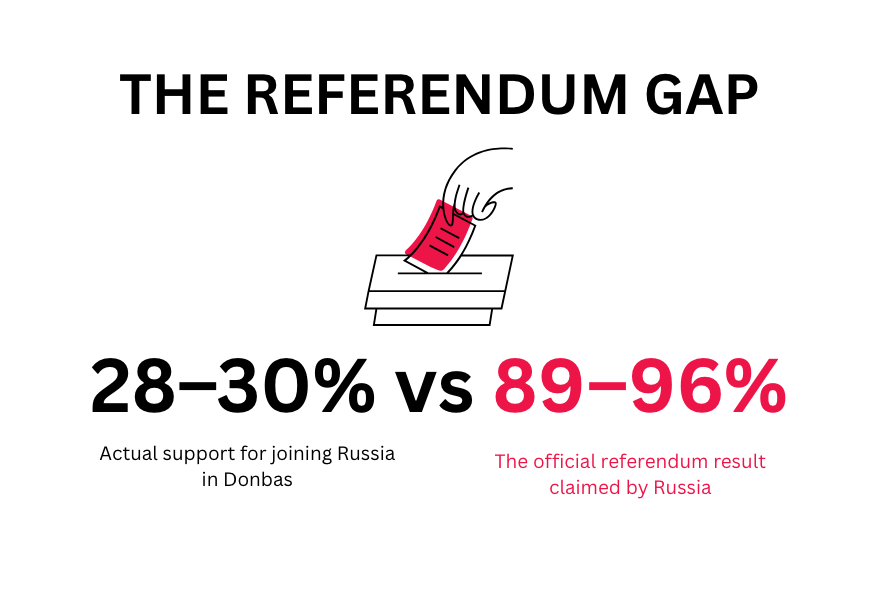
That story is the key argument of Russia’s justification for the war. It was the argument for the doubtful referendums of 2014, which claimed 89 to 96 percent support for joining Russia. It was the argument for the ‘special military operation’ in 2022. It is the argument that continues to circulate in German debates about whether a negotiated settlement should recognise Russia’s territorial gains.
What we found, over seventeen interviews conducted in Ukrainian prisoner-of-war camps in 2025, was something different. Something the official Russian narrative cannot accommodate, and that most Western coverage still has not properly absorbed.
The men in these camps — prisoners captured fighting in Russian uniforms, many of them from the very territories Russia claims to have ‘liberated’ — largely did not want to join Russia. Many did not think of themselves as Russian. Several had never thought about the question of identity at all, until a war they did not choose forced it on them. And almost none of them could explain, coherently, why that war was being fought.
What happened so far
For three decades, the Donbas — the industrial east of Ukraine, encompassing the Donetsk and Luhansk regions — was cultivated by Moscow as a zone of special influence. Russian was the dominant spoken language. Cross-border work in Russia was routine. Local political elites had long-standing financial and ideological ties to Moscow.
When Euromaidan erupted in 2013 and 2014, and then‑president Viktor Yanukovych fled, those elites moved quickly. With Russian military, financial and political support, armed groups seized government buildings and declared self-proclaimed “people’s republics.” Referendums were held — under occupation, without independent monitoring — and announced results of 89 to 96 percent in favour of independence.
A month before those referendums, the Kyiv International Institute of Sociology surveyed the same population. It found that 28 percent of Donetsk residents and 30 percent of Luhansk residents supported joining Russia. The gap between those two numbers — roughly 60 percentage points — is not a footnote. It is the fact around which this entire story turns.
Out of six million residents of the Donbas, nearly one and a half million fled to Ukrainian-controlled territory in the years that followed — the largest forced displacement in Europe since World War II, until February 2022. Thousands of them joined the Ukrainian armed forces. The men who stayed were eventually absorbed into the Russian war machine. Russia managed to mobilise more than 300,000 people from the occupied territories to fight against their fellow citizens. Many had no say in it.
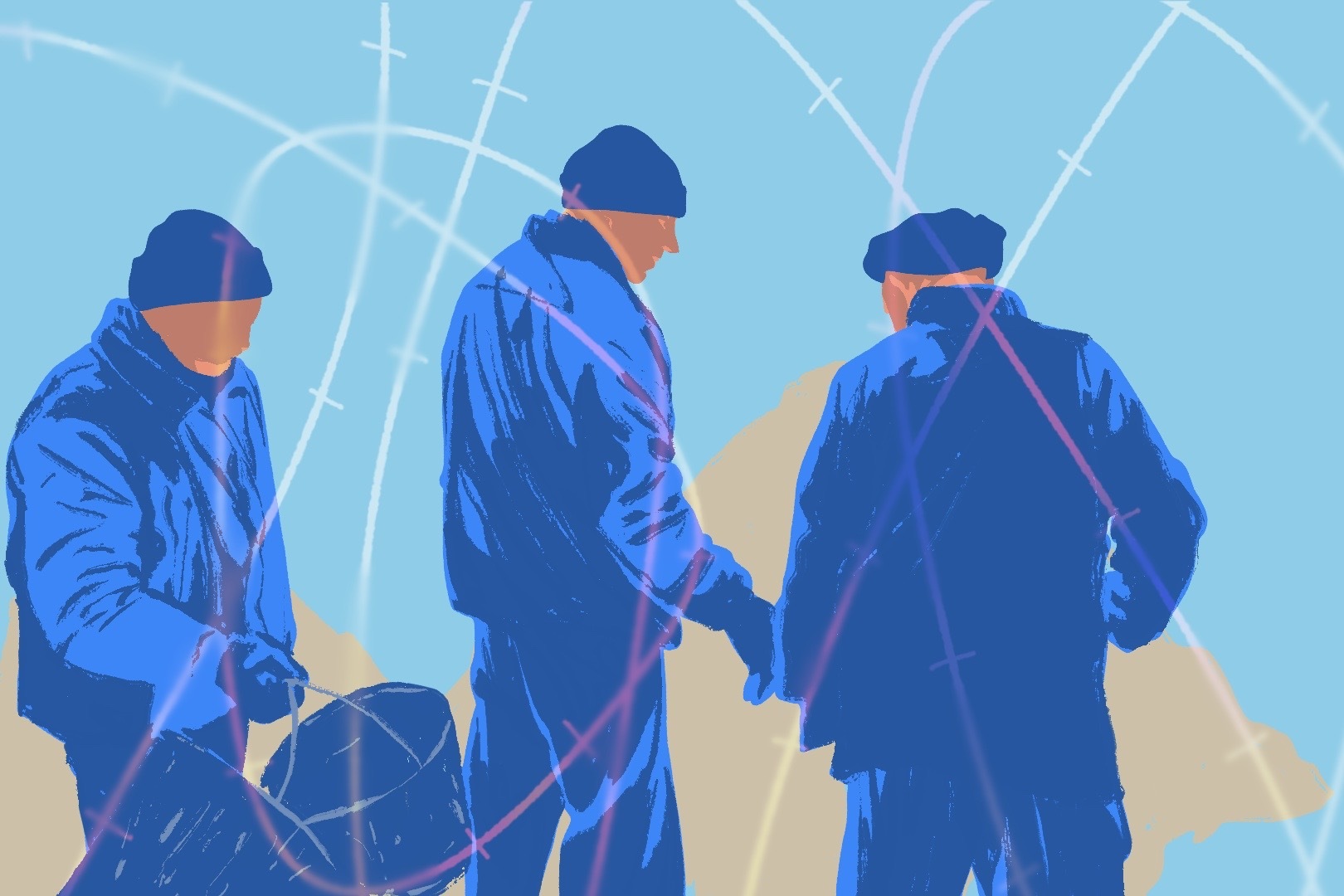
The people behind the front line
The air inside the prisoner-of-war camp smells of cheap laundry detergent and cigarette smoke — a combination so persistent it can turn your stomach. The men move through the compound with the unhurried shuffle of people who have nowhere to be and no clear sense of what comes after this. Their faces are not frightened. They are emptied out.
Vitalii is forty. He grew up in Kharkiv speaking Russian, worked seasonally in Russia as a teenager, and in 2017 moved to Moscow, married a Russian woman, and received a Russian passport. He kept his Ukrainian one.
On the night of February 24, 2022, his wife woke him. Something incomprehensible was happening. They watched the news — Ukrainian and Russian, side by side. Vitalii recalls thinking that the people at the top, on both sides, had already sorted it out. Why would they need him? He was a cook. He had no military training.
A year passed. In June 2024, he was summoned to the draft office. He tells this part of the story with the recorder turned off. There was pressure, he says, and threats. He signed a contract believing he was going to Kaliningrad. He ended up at a training facility near the Ukrainian border, learning to operate a machine gun. He says he tried not to think about who he would be shooting at.
Four days into deployment in the Donetsk region, he was wounded. Vitalii hid. When he heard Russian voices, he began shouting for help. The soldiers who found him were Ukrainian. They took him prisoner. Because he had never renounced his Ukrainian citizenship, he was convicted of state treason and sentenced to fifteen years in prison. He accepts the sentence but considers it unfair.
His story is not unusual. Across seventeen interviews, the same question arose with every prisoner: Who do you consider yourself to be? It did not produce answers. It produced negotiations — with language, geography, the passport that happened to arrive in the mail. For most, it was a question they had never thought to ask before the war asked it for them.
Igor, 38, had a formed Ukrainian identity. He grew up in Donetsk, the son of ethnic Russians, but as a teenager, he was good enough at fencing to compete internationally for Ukraine. He travelled to Hungary and Poland with the national team.
I did feel Ukrainian, of course. I competed for Ukraine. – Igor (age 38)
And yet he voted at the illegal DNR referendum in 2014 because, he said, EU integration would harm cross-border ties with Russia. He ended up in a Russian uniform.
A carpenter from a small Luhansk town — forty-one, the mines long shut down — paused for a long moment when asked about his identity. He spoke Russian at home. After he thought about it, he invented a word: “Ukraino-Russian.”
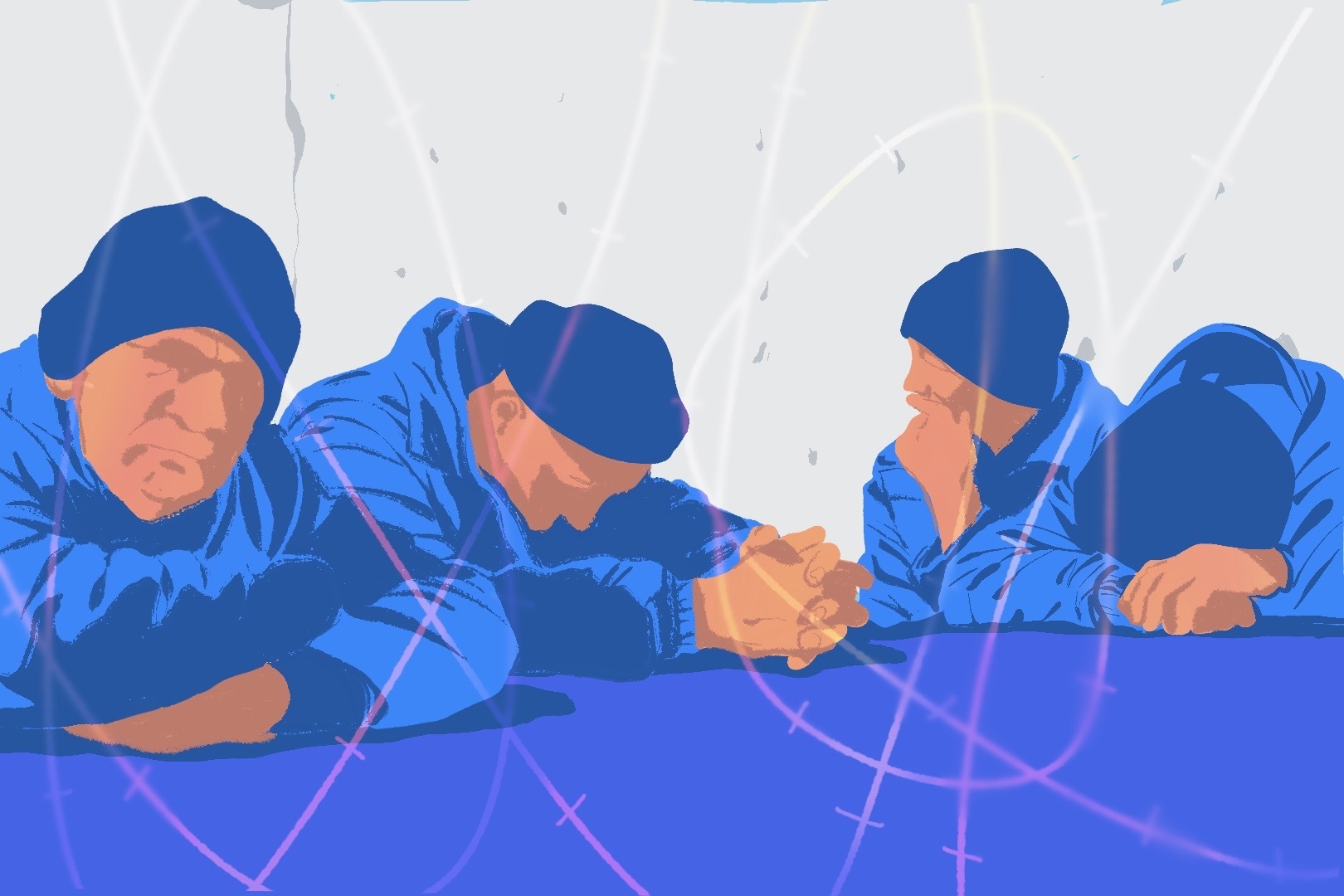
I never even thought about whether I was Ukrainian or Russian. I lived in Ukraine, so I was Ukrainian“ – carpenter (age 41)
A twenty-four-year-old said he first thought about identity when he turned sixteen and his passport from the self-proclaimed Luhansk People’s Republic arrived. Until then, it had not occurred to him to ask. The document prompted the question; the document also supplied the answer.
A thirty-year-old who had worked at a chemical factory held two technical diplomas and a passport of the self-proclaimed Donetsk People’s Republic.
Before this, I considered myself a Donetsk guy. Now we are under Russian rule, and in fact, we are nobody. – worker (age 30)
The tram driver from Donetsk, 49, was told by his managers to report to the military commissariat. He went, as you go when managers tell you to. His phone was taken. His documents were taken. Five hundred men like him were processed that day. In March 2022, he was at the front in the Kherson region. He had imagined, to whatever extent he had imagined anything, that he would be defending Donetsk.
What are we doing here in Kherson? We need to liberate the Donetsk region.“ – tram driver (age 49)
Asked who started the war, he paused. Russia, he said, eventually. “Russia has always tried, geopolitically, to influence Ukraine.” Then he stepped back from the observation. He reached for a story his grandfather used to tell. The cow, his grandfather said, doesn’t care whether the hay is Ukrainian or Russian.
What this means for how we understand the war
Russia’s justification for the 2022 invasion rests on a claim about identity. The people of Donbas and Crimea, the argument goes, are Russian. They want to be part of Russia. Their presence in Ukraine was an injustice the war corrects.
The men in these camps are the human evidence for that claim. They wore Russian uniforms. Some of them fired on Ukrainian positions. Russia mobilised them.
But when you ask them who they are, almost none of them say Russian. They say Ukrainian, or Donetsk, or Ukraino-Russian, or nobody, or Soviet, or they don’t know. Almost none of them volunteered for ideological reasons. None of them offered Russian propaganda narratives — denazification, NATO aggression — as their own explanation. The most common position, in response to the question of why the war is being fought, is deliberate silence.
This matters for how Europe — including Germany — engages with proposals for a negotiated settlement that would accept Russia’s territorial acquisitions as a fait accompli. Those proposals often rest, implicitly or explicitly, on the assumption that the people of the occupied territories prefer Russian rule. The survey data from 2014, now corroborated by these testimonies, suggests the opposite. The men who ended up in Russian uniforms were not representatives of a population demanding to join Russia. Many of them were people Russia mobilised by force after years of occupation had degraded their lives and narrowed their options.
Three prisoners, independently and in separate interviews, described almost the same experience: being made to feel unwelcome on Ukrainian-controlled territory after 2014, treated as strangers because they spoke Russian. Whether it happened to each of them exactly as described, or whether the story had taken on a collective shape through years of retelling, cannot be verified. That all three carried it says something about how a feeling can settle into identity even when it begins as a rumour.
Russia’s narrative about eastern Ukraine was always a political construction. The people caught inside it are more complicated, more ambivalent, and more human than the narrative allows. The cow parable is not resignation — it is a form of dignity. The tram driver knows exactly what happened to him. He has simply decided, for now, not to carry it.
How can I stay informed
- The Reckoning Project — The investigative organisation that conducted these interviews. Documenting war crimes and testimonies from the conflict in Ukraine, in Ukrainian and English.
- Ukrainska Pravda — Ukraine’s leading independent news organisation, reporting in Ukrainian and English on the war, politics and society.
- iStories (Important Stories) — Exiled Russian investigative outlet producing data-driven investigations into Russian military casualties, finances and war crimes.
- Mediazona — Independent Russian outlet based outside Russia, covering human rights, the justice system and military losses. Collaborates with the BBC Russian Service on casualty documentation.
METHODOLOGIE
Over the course of seven visits to prisoner-of-war camps in 2025, The Reckoning Project conducted more than forty interviews with detainees, including citizens of Brazil, Nepal, Belarus, Russia and other countries. Seventeen of these were with prisoners from the temporarily occupied territories of Ukraine and form the basis of this investigation. Researchers also documented more than fifteen cases in which potential interviewees declined to participate. All interviews were conducted voluntarily and anonymously. Each participant signed informed consent allowing for the collection of personal information and the publication of their story. Certain identifying details have been removed or altered to protect the safety of interviewees.
– – – – – – – – – – – – – – –
Editing: CORRECTIV.Exile editorial team
Research: The Reckoning Project
Illustration: Anwar

