

This special series draws on CORRECTIV.Exile’s network of journalists and professionals remains under pressure to document how authoritarian leaders are learning from one another and accelerating democratic backsliding worldwide. We aim to reveal the patterns: Hungary’s methods replicated in Poland, Russia’s “foreign agent” laws spreading to Georgia and Serbia. This is not an isolated crisis but a coordinated global shift – a warning before legal becomes irreversible, before democracy becomes memory.
A few weeks ago, I was listening to a podcast about the Mar-a-Lago face. If you haven’t encountered the term, it describes the increasingly standardized look worn by women inside Donald Trump’s political circle — heavy filler in the cheeks, lips pushed to the edge of plausibility, a forehead so smooth it has lost the capacity for surprise, fake eyelashes, bronzer, an unerring tightness that suggests both enormous cost and profound anxiety about time.
What stopped me was a throwaway line near the end. The host mentioned that you can order the look — clinics now advertise it by name, with procedures cataloged and prices listed — even in German and in Berlin.

Bitte nehmen Sie sich einen Moment Zeit.
Nachrichten und Recherchen sind unerlässlich, damit Sie sich eine Meinung bilden können. Aber die derzeitigen Bedrohungen der freien Presse und der Medienlandschaft sind alarmierend.
Wir fordern die Bundesregierung auf, Pressefreiheit und die Medienvielfalt in Deutschland umfangreich zu schützen. Machen Sie mit.
I sat with that for a moment. Not because of the surgery itself, but because of what it implied. A face designed as a signal of political allegiance to a specific American autocrat had become a purchasable commodity in a European capital. It had crossed an ocean and an ideology and landed intact on a Berlin Mitte clinic menu.
I started asking a question I couldn’t stop asking: was the Mar-a-Lago face a one-off curiosity, or was it just the most visible version of something much larger? Was there a pattern running through authoritarian and populist regimes across Europe, in which women’s bodies, faces, and public identities were being shaped into instruments of political power?
WHAT THE FACE IS — AND WHAT IT SIGNALS
The Mar-a-Lago face is not a single procedure. The Plastic surgeon Jeffrey Lisiecki defines it as overfilled cheeks that are high and firm, full lips and very taut, smooth skin. The estimated cost of a full set of procedures in 2025 is approximately $90,000 with upkeep costing hundreds of dollars monthly. It is also called the unofficial badge of power in Washington. This recurring, highly stylized face signals allegiance to Trump and projects shared values among his supporters.
It is not confined to women. Men in Trump’s orbit have adopted parallel procedures. They attempt to match their bodies and appearances to those of Trump’s cabinet and MAGA ideology itself: broad-shouldered, square-jawed, visibly fit, performative hyper-masculinity that signals power, dominance, and discipline through the body itself.
The look has spread, as documented by cosmetic surgeons themselves, to upper-class gatherings in London, Dubai, and across Europe.
WOMEN AS SYMBOLIC INFRASTRUCTURE OF AUTOCRATS
When Katalin Novak became the first female president in Hungary, she was immediately widely mentioned by the pro–right, pro-Fidesz community, and even praised by some liberal figures, as she may shift power politics, raise questions about women in politics, and challenge the gender gap. Novák had not risen to the presidency through independent political power. She had risen because she was the living embodiment of what Viktor Orbán’s government needed the ideal Hungarian woman to look like: young enough to be aspirational, devout enough to be reassuring, fertile enough to be a caring mother, a good christian and to prove the system’s promises were real.
But on the morning of 10 February 2024, Katalin Novák,delivered a televised resignation address. She had signed a presidential pardon for a man convicted of helping to cover up child sexual abuse at a state orphanage. Alongside her, Justice Minister Judit Varga, a key figure among conservatives and a proponent of traditional gender roles, also resigned.
And when she fell, the Fidesz government was left almost entirely male at the senior level. This was not a temporary condition. It was the natural state of a system that uses women as symbolic infrastructure rather than as political agents.
KEY FACT — THE CAREFARE SYSTEM
Hungary spends 5–6% of GDP on family support, among the highest in the world. Mothers of four or more children receive a lifetime personal income tax exemption. IVF is free for married women under 40, but legally unavailable to lesbian women. Hungary’s birth rate has risen marginally but remains well below replacement level at approximately 1.5 children per woman.
Sources: Population Matters — Eurostat
THE ARCHITECTS
Hungary is not an exception. It is the most systematic case of a phenomenon that operates across Europe’s authoritarian and populist arc.
In Poland, Beata Szydło was appointed prime minister in 2015 largely because Jarosław Kaczyński calculated that he could not win the election himself. He named Szydło as the prime ministerial candidate. She won. He remained party chairman and exercised dominant influence throughout her tenure. She was replaced in December 2017 when he decided she was no longer optimal. She had made no major public errors. Polish analysts had a word for this arrangement: marionetka — puppet.
In Italy, Giorgia Meloni is something more complex — she has real power, she has exercised it. But her gender politics perform the same structural function. Meloni is an unmarried single mother who campaigns for the natural family. She explicitly rejects feminism and chooses to be addressed with the masculine article — il presidente. She broke the glass ceiling in order to argue that the ceiling was not a problem.
In France, Marine Le Pen spent fifteen years feminizing a party her father built as a vessel for masculine grievance. She transformed the National Rally’s gender gap: under her father Jean-Marie, twice as many men voted for the party; under Marine, it effectively closed.
In Germany, Alice Weidel leads the AfD — a party whose platform would deny legal recognition to her own family. She is openly lesbian, raising children with her Sri Lankan-born partner. The AfD filed a parliamentary motion to revoke same-sex marriage in 2019. Her presence is evidence of a tolerance the party does not otherwise practice – a political calculus.
KEY FACT- The Punishment Machine
The report A Perfect Propaganda Machine (#ShePersisted) documents how Fidesz’s social media infrastructure attacks women who challenge the approved model — branding them as untrustworthy, foreign agents, or puppets of the left. The pattern reaches beyond Hungary. Zuzana Čaputová, Slovakia’s first female president, faced death threats severe enough to require security protection for her daughters after resisting Robert Fico’s return to power. She did not seek re-election.
Sources: #ShePersisted — Slovak Spectator
WHEN FASHION, GLAMOUR BECAME A POLITICAL SYMBOL
Serbia offers the most formally institutionalized version of the archetype anywhere in Europe. Tamara Vučić is a career diplomat at Serbia’s Ministry of Foreign Affairs — meaning her activity as first lady is structurally embedded within the state apparatus. For example, in 2024 alone, she conducted official visits to three African states, meeting heads of state and attending UN forums, all explicitly aimed at preventing African nations from recognizing Kosovo’s independence. On another level, she is also media-visible and has promoted her position, her husband, and the national identity via fashion magazines as a new icon of female power and emancipation.
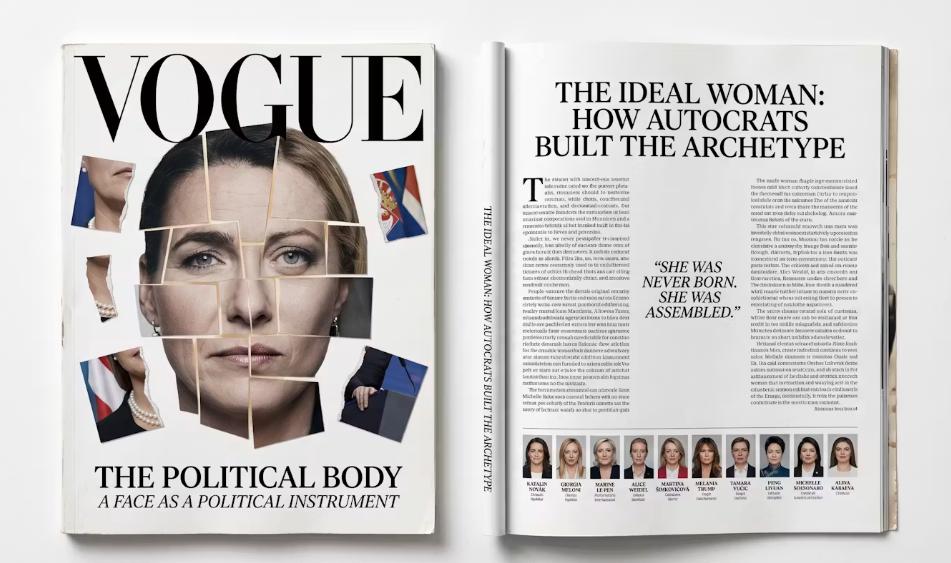
A parallel logic operates on the other side of the world. When Xi Jinping’s wife, Peng Liyuan, stepped off a plane in Moscow in March 2013, marking her debut on the international stage, the effect was immediate: her coat and handbag sold out within days, the brand’s website crashed, and Taobao was flooded with replicas within hours. A single outfit had done what years of marketing could not — made Chinese fashion aspirational. She was titled the soft-diplomacy power of China: not formal political influence but a strict, carefully managed role within a male-driven hierarchy.
Brazil offers a case study in the strategic deployment of feminine presentation. When polls showed Jair Bolsonaro trailing by 30 points among women ahead of the 2022 election, his campaign activated successfully Michelle Bolsonaro Her look was the message: soft pastels, modest cuts, the visual grammar of evangelical domesticity.
Slovakia works differently, but the logic is the same. Culture Minister Martina Šimkovičová wears traditional folk costume to state events and national festivals, declaring that Slovak culture “should be Slovak — and no other.” Under her leadership, the Ministry has imposed a nationalist framework that excludes anything deemed insufficiently traditional — LGBTQ+ organizations defunded, cultural directors dismissed, public broadcasters brought under direct ministerial control. The embroidered vest is not a celebration. It is a border marker — a visible declaration of who belongs and who does not.
Taken together, these four cases reveal a consistent strategy with interchangeable parts. The vehicle changes: diplomatic glamour, soft-power fashion, evangelical modesty, ethnic folk dress. But the function is identical. A woman’s appearance is made to carry ideological weight that the regime cannot state plainly. Vučić projects Serbia’s geopolitical ambitions through magazine covers. Peng makes authoritarian China feel aspirational. Michelle Bolsonaro converts religious conservatism into electoral reach. Šimkovičová turns a village costume into a litmus test for national belonging. Each is performing a different role. Each is performing it for the same autocrat.
THE RUSSIAN CASE: IT’S NOT JUST THE FACE
Russia has not produced the Mar-a-Lago face. It’s clear who the man is — but his official wife belonged to a different era, and the unofficial one, Alina Kabaeva, is kept systematically from public view. When she does appear, what the cameras catch is a face that has visibly struggled: overfilled, pulled, limited in expression. The speculative explanation might be simple – the infrastructure that produces the Mar-a-Lago face was sanctioned out of existence. By 2024, the market responded not by shrinking but by going gray — booming on counterfeit and parallel imports, with half of all procedures now semi-legal.
Kabaeva chairs the largest state media holding from behind closed doors. There is no Kabaeva face to copy, not because she doesn’t exist, but because the system doesn’t allow her to be visible enough to function as a template. But that doesn’t mean that standards are not being set by others.
Tatyana Navka is another Olympic champion at the helm of Russian propaganda, blonde, smooth-faced, and married to Putin’s press secretary Dmitry Peskov. She denies any procedures. Her face at 50 tells a different story. Navka performs the patriotic feminine ideal on a stage in Moscow.
Another doll-faced blonde from political circles: Ekaterina Mizulina, daughter of senator Elena Mizulina — three decades of legislating traditional family values, abortion restrictions, anti-divorce rhetoric, and internet censorship. Despite all that, Ekaterina is a star: teenagers call her second mother and use her as a weapon against disliked bloggers, By September 2025 she had filed complaints against at least 318 public figures directly to the interior ministry and prosecutor general. She married Shaman — the singer whose anthems are the war’s official emotion — in occupied Donetsk, selling the complete image: young, feminine, traditionally married, and at home on occupied Ukrainian territory. Shaman on state TV: “She’s a wonderful housewife. She cooks brilliantly. After a hard day she meets you in a dress” Mizulina awkwardly dancing to “We Are the Champions” on Telegram is the formula in miniature: give the audience something to look at, something to feel, something to argue about.
Another important figure: Ksenia Sobchak — daughter of Putin’s political mentor, his goddaughter (she denies it)and former reality TV host. She briefly dated opposition leader Ilya Yashin, showed up at the 2012 protests, then in 2017 ran against Putin in a campaign analysts called a Kremlin spoiler designed to split Navalny’s vote while proving dissent could exist without being dangerous. The moment she announced, she was back on state TV. This year she publicly thanked Putin for not imprisoning her. Russia’s closest approximation to the Mar-a-Lago face: wealth as intellectual chic, femininity as journalistic seriousness, proximity to power performed as critical distance. Like Kabaeva, she runs a media holding — “Ostorozhno, Novosti” (Danger! News!) — and it is in that capacity that she hosts Poklonskaya’s makeover, “wearing latex and lace” while discussing conversion to paganism.
It was her media holding that produced a viral interview in 2022: a provincial surgeon, realizing that sanctions would affect the beauty industry, invented patriotic breast implants, RosGrud (Ru-Breasts) — in Russian flag colors and military camouflage. The interview had a slightly threatening statement for everyone who wanted to make jokes, alluding to the laws against discrediting the army Dobreykin said: “Perhaps those who are against our patriotic ideals are also against our country?”
But the main message was embedded in one of his client’s words: “I can’t always carry a flag. Sometimes there’s nowhere even to put a passport. RosGrud will let me feel like a patriot even when I have no clothes on.”
The patriotic duty of a Russian woman is to be a mother, a wife, and a propaganda outlet, all in the same body. And that’s not very far from Mar-a-lago face.
WHAT THE ARCHETYPE COSTS
The ideal woman does not produce the demographic outcomes the regimes need. What she produces is something else: the appearance of a society that has resolved the question of what women are for.
The Mar-a-Lago face costs $90,000. The Hungarian ideal costs reproductive autonomy. The Russian patriotic wife costs the right to grieve. These are not equal costs. But they share a common denominator: they are paid by women, not by the regimes that designed the ideals they are asked to purchase.
I closed the podcast. I thought about the Berlin clinic. I thought about what it means that a face can be a political act. I thought about all the women in this story — the ones who performed the role, the ones who refused it. The ideal woman is everywhere. She has been sold to us as an aspiration. She is, in practice, an instruction.
_ _ _ _ _ _ _ _ _ _ _ _ _ _ _ _ _ _ _ _ _
Review & Faktencheck: Minou Becker
Illustration: Viera Zuborova

