
Azerbaijan: The Price of Victory and the Silence of Dissent
In this article series, we take a second look at current events in countries that often remain only briefly spotlighted in German reporting. Together with local experts, we ask: What political and social developments lie behind the current events that we see in the news? What does this mean for democracy and media freedom? With our exile expertise, we want to reveal global connections and understand what we can learn from this for free, democratic coexistence. In this episode, Azerbaijani journalist Fatima Karimova writes about the repression of media workers in her homeland and why the European Union repeatedly turns a blind eye to it.

Introduction: The Uncomfortable Question
What do you think of when you hear the word Azerbaijan?
For many in Europe, the image is all high-speed glamour: the thrilling turns of the Formula 1 Baku Grand Prix or the bright lights of Eurovision from years past. Yet, the reality inside this South Caucasus nation – nestled between Russia, Iran, Turkey, Georgia, and Armenia – is dramatically different. This is a country surrounded by three former empires, having been part of one for a long time. Despite presenting a modern image, it is, in reality, one of those countries where journalists and critics are routinely detained, persecuted, and punished for questioning the government.
The best way to understand this stark contradiction is through a question I was recently asked at a public talk:
“If young people in Azerbaijan started protesting—you know, a real Gen Z wave—would anyone inside the country dare to report it?”
The question was so simple, yet so devastating, it hung in the air. It landed especially hard because of the timing. We were barely a month shy of the second anniversary of the latest ongoing crackdowns the country has seen. That period resulted in dozens of journalists and activists being arrested, many of whom are now serving prison sentences on trumped-up charges.
The silence after the question was the real answer. The truth is, probably no one would dare to report. Or, if they did, the consequences would be ruinous—their lives, their freedom, destroyed. This silence actually tells you everything you need to know about modern Azerbaijan. It shows how the government has systematically tried to dismantle every single bit of independent reporting. Crucially, it speaks to the fact that when I was asked that question, the Azerbaijani independent media outlets no longer had newsrooms in the capital, Baku. They’d been forced to pack up and flee into exile, leaving dozens of reporters to figure out how to continue their jobs from abroad.
What happened so far
In the 1990s Azerbaijan as well as Armenia were struggling to survive after the collapse of the Soviet Union. In this chaotic time of upheaval, a sore point quickly crystallized: the question concerning the region of Nagorno-Karabakh.
For over 30 years, the armed conflict over the mountainous enclave between Azerbaijan and Armenia served as the Azerbaijani government’s ultimate political shield. Any demand for democracy, transparency, or reform was instantly dismissed with the powerful counter-argument: “We must prioritize solving the occupied territories; democracy can wait.” The conflict was the nation’s main agenda, a convenient excuse that pushed political freedom off the table for decades.
The second war in 2020 lasted 44 days, but even after the peace announcement and the ceasefire, the conflict was not fully resolved. The mountainous areas—Lachin and Khankendi (called Stepanakert by Armenians)—remained under the control of the Armenian forces. The unrecognized entity known as the Republic of Artsakh continued to exist.
In September 2023, a new outbreak of fighting occurred, lasting one day. The Azerbaijani government described it as a “military operation.” Following this event, the local Armenian population left the region and relocated to Armenia. After this one-day conflict, the entirety of Karabakh came under the control of the Azerbaijani military.
Today, while the guns have largely fallen silent, the peace isn’t actually here. For the last couple of years, both Azerbaijan and Armenia have seemed constantly this close to signing a comprehensive peace treaty and finally normalizing their relations. Yet, despite almost five years of intense discussions, a signed deal remains elusive.
What has been achieved with a shared transit route and a proposed 17-point negotiated peace agreement is primarily initial agreement, which were brokered under the observation of the US president Donald Trump and allowed him to politically claim success, adding the countries to his list of places where he ostensibly “brought peace.” The repression wave in the county wasn’t of any importance for this self-proclaimed “peace president”.
In early November 2025, Azerbaijan is immersed in celebrations for Victory Day, a national holiday established in 2020 to mark the end of the 44-day Second Karabakh War. The core of this celebration is a grand military parade, designed to showcase the nation’s military resurgence. The event is a massive statement of national power and sovereignty, reinforced by the presence of key allies: both Turkish President Recep Tayyip Erdoğan and the Prime Minister of Pakistan Shehbaz Sharif have attended, symbolizing the tripartite strategic partnership.
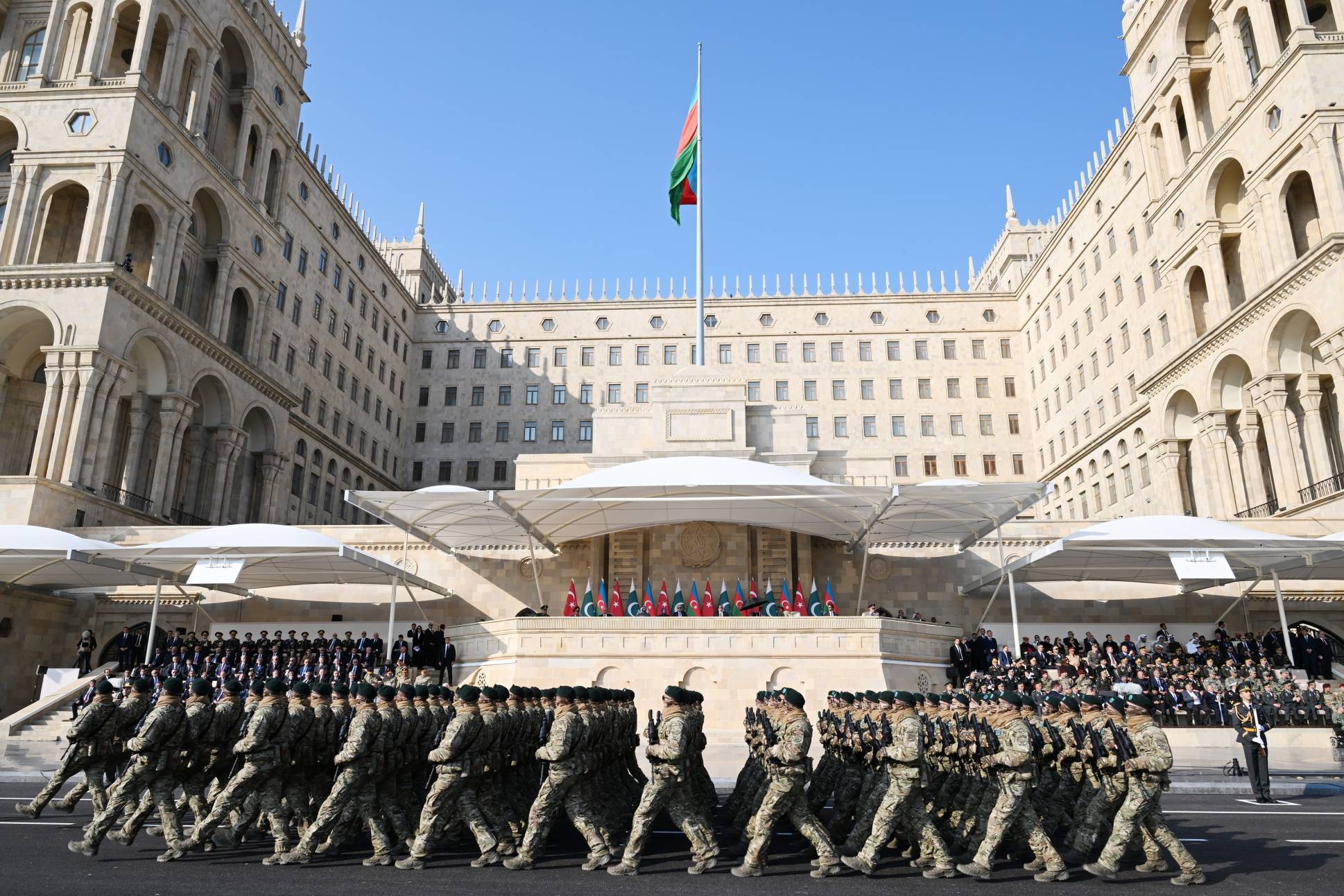
This is the strange, contradictory tightrope Azerbaijan walks today: a nation that is, understandably, celebrating a massive military victory—a moment of intense national pride—while the government simultaneously silences anyone who dares to complain. The drums of victory are loud, but the voices of dissent are being drowned out.
How did journalists become political prisoners?
Today, Azerbaijan has won the military fight, so that old excuse is gone. You’d think that would open the door for more democracy, but the opposite has happened. Now, the government just tightens its grip even harder. Because the conflict had lasted so long, almost no one believed that a real war and the actual retaking of Karabakh was possible. However, it did happen, and for a time it boosted Ilham Aliyev’s approval ratings. Many people supported him and viewed him as a “victorious leader” who had fulfilled his promise.
But this also created the basis for another perception: people began to accept detentions and persecution of independent media and political activists, believing that Aliyev was always right. He repeatedly stated, “I know what to do and how to do it.” The idea became that, since Karabakh was liberated thanks to his knowledge and political strategy, it must also be wise and justified to arrest government critics—because such critics were seen as being against Azerbaijan’s victory.
Starting in November 2023, 28 employees from three major independent media outlets operating inside the country—Meydan TV, Toplum TV, and Abzas Media—were imprisoned. The crackdown did not stop there; in the following months, additional journalists and media workers were also arrested. Today more than 30 journalists and media workers are detained and these three major independent media outlets saw their Baku newsrooms forcibly closed. The office of Toplum TV´s office in Baku was even sealed following a police operation that allegedly “discovered” illicit foreign funds.
The authorities’ legal strategy has been uniformly cynical: the accusation against almost all detainees is the same—smuggling foreign currency. This widely disputed charge, which carries heavy prison sentences, is used to criminalize the funding and operation of independent media. This tactic was brutally underscored in June, when the Baku Serious Crimes Court delivered devastating, lengthy sentences to seven journalists from Abzas Media and Radio Free Europe/Radio Liberty (RFE/RL). The sentences ranged from seven-and-a-half to nine years for director Ulvi Hasanli, editor-in-chief Sevinc Vagifgizi, and others. While the court convicted them of acting as an “organized group” on charges that included smuggling, money laundering, and tax evasion, international watchdogs universally condemned the verdict as the outcome of a purely political trial aimed at silencing reporting on high-level corruption.
As a result of this purge, the country has become dramatically more closed. The dozens of reporters who were not imprisoned were forced into exile, suddenly finding themselves working in a devastating information blockade.
They now lack direct access to sources and the ability to verify information on the ground. Crucially, any work or attempt by collaborators to assist independent journalism inside the country will now be met with immediate and severe punishment, making it nearly impossible to hire new correspondents or operate safely. The crackdown has not just silenced critics; it has created a void of objective information.
Azerbaijan has always been a hostile environment for independent journalists. Even before the 2023 crackdown, operating was a constant challenge: police would prevent reporters from covering protests, temporary detentions were common, and journalists faced continuous persecution simply for doing their jobs. This atmosphere of official hostility and violence was already the “normal” for critical reporters. For example, during one feminist protest, journalists from Mikroskop Media were subjected to police violence, forced to delete their live stream, and faced horrifying threats of sexual assault.
Meanwhile, operating parallel to the constant pressure on independent media and critics, the government has invested heavily in a colossal propaganda machine. It funds hundreds of websites, social media accounts across Facebook, TikTok, and Instagram, and more than ten TV channels whose sole purpose is to spread state narratives and repeat official lies.
This vast network operates based on explicit instructions funneled directly from the Presidential Administration. The government doesn’t bother with constant back-and-forth demands to delete “improper” comments; instead, it proactively sends out templates. These specific directives include suggested sentences, talking points, and even the “correct” angle for discussing potential topics, whether internal or international.
The cynical use of this machine even extends to commercial interests. When the powerful First Family-linked conglomerate, Pasha Holding, launched a new taxi business, local TV channels were reportedly handed instructions that “suggested” criticizing rival taxi companies and “advising” on favorable angles—effectively weaponizing state-controlled media for private commercial benefit.
Despite this overwhelming and heavily funded operation, independent media outlets fought back with extremely limited resources. They did their best to cover the real problems of the country: the complaints of ordinary citizens, women’s rights violations, protests, and crucial anti-corruption investigations, serving as the essential, if vulnerable, watchdog for the public.
Gas for Silence: How Europe’s Energy Needs Mute Criticism
While some journalists remain in pre-trial detention and have been waiting for verdicts for months, the country’s reputation continues to plummet on the global stage. In the latest Reporters Without Borders (RSF) World Press Freedom Index, Azerbaijan is ranked 167th, falling squarely into the “Very Serious” category—the worst possible designation. RSF is not alone; the country consistently receives low rankings from nearly every major international monitoring body for political rights and civil liberties.
These grim index scores and continuous calls for the release of political prisoners by international organizations are accompanied by a deafening silence of politicians. The diplomatic chorus of condemnation that follows human rights abuses elsewhere is muted here, largely because the silence is purchased. The criticism from activists and watchdogs is drowned out by the noise of recent, high-stakes gas deals signed between the European Union and Azerbaijan, prioritizing energy security over human rights.
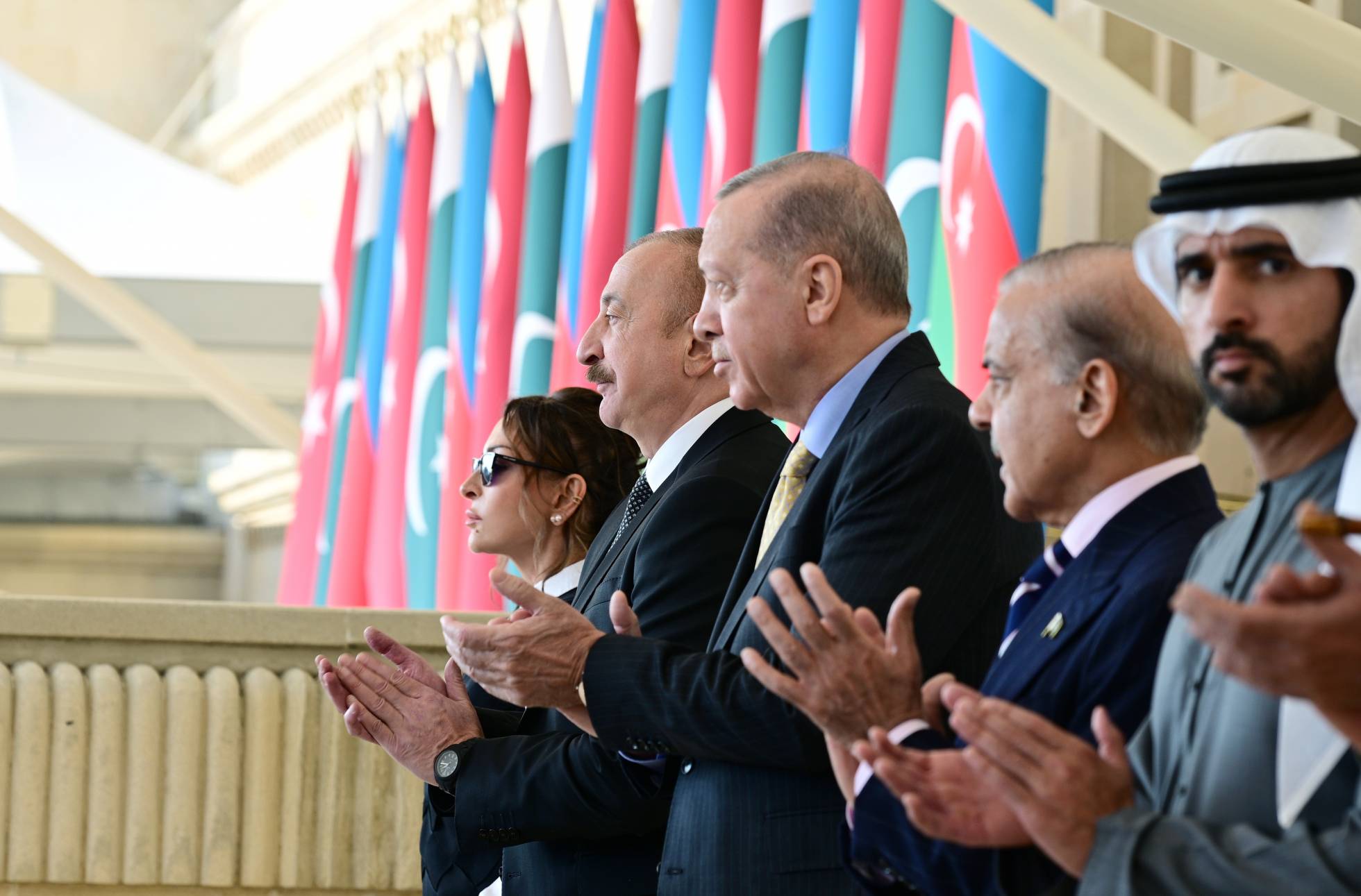
For the European audience, the most important tie is energy. Since Russia’s full-scale invasion of Ukraine, Azerbaijan has been catapulted into the role of a vital, non-Russian supplier of natural gas, channeled through major pipelines to Europe. In 2022 Ursula von der Leyen visited Baku and signed the energy memorandum with Ilham Aliyev. Based on this memorandum the aim is to double Azerbaijan’s gas supplies to Europe by 2027, reaching 20 billion cubic meters per year. Before that Azerbaijan has started to explore gas to Italy, Greece and Bulgaria in 2020. It is being exported through the Trans Adriatic Pipeline and the turnover is 18 billion USD.Besides the gas Azerbaijan plans to export green energy too to EU. In this regard, Azerbaijan last year signed agreements with Masdar (UAE) and ACWA Power (Saudi Arabia) to build solar and wind plants.
Ursula von der Leyen is not the first and only EU official who visits Azerbaijan. In the last years several EU Ministers have been to Baku, to attend some events and meetings. In 2024 July, the Prime Minister of Hungary Viktor Orban visited Shusha for the Informal Summit of the Heads of State of the Organization of Turkic States. This massive, multi-billion dollar energy deal is a double-edged sword. For the European Union (EU), it provides a lifeline for energy security. But for activists and journalists in Baku, it has become a powerful shield for the ruling regime.
On the second View: The Silence of Dissent
While dozens of independent journalists and activists spend months and years in jail, the government faces virtually no serious criticism for its high-scale pressure and crackdowns. Europe gets its necessary supply, and in return, its politicians find it diplomatically easier to ignore or minimize the severe human rights violations and political dissent in Azerbaijan.
The human cost is simple: Azerbaijan’s oil and gas wealth grants its rulers the power to act with impunity against their critics at home. The world’s urgent need for their energy, sadly, has become the ultimate protection for authoritarian rule.This arrangement confirms a grim and difficult lesson for us all: for Western leaders, the urgent need for gas on the continent has tragically proven to be more important than the fate of independent journalists and the democratic values Europe claims to uphold.
How can I stay informed
- Mikroskop Media: This exiled, Berlin-based Azerbaijani and partially English-language outlet specializes in producing explanatory materials and investigations, often in collaboration with organizations like the Organized Crime and Corruption Reporting Project (OCCRP). It was launched by two Azerbaijani journalists in 2018.
- Meydan TV: A long-standing, exiled media outlet based in Berlin, Meydan TV has been operating for over ten years. Despite the detention of ten of its journalists during the crackdown, it continues its crucial work covering Azerbaijan in Azeri, English, and Russian.
- Azadlıq Radiosu (Radio Free Europe/Radio Liberty – RFE/RL): The Azerbaijan Service of Radio Free Europe/Radio Liberty (RFE/RL), it continues its operation, providing independent news coverage of Azerbaijan from abroad.
- Abzas Media: Previously based in Azerbaijan, Abzas Media was forced to continue its work in exile following the 2023 crackdown, operating now with limited resources. The outlet, known for its damning anti-corruption investigations, currently has at least three of its managers and journalists unjustly held in jail.
– – – – – – – – – – – – – – – – – – –
Editing: Minou Becker
Graphics: https://president.az/
Communication and Social Media: Katharina Roche

