

This special series draws on CORRECTIV.Exile’s network of journalists and professionals remains under pressure to document how authoritarian leaders are learning from one another and accelerating democratic backsliding worldwide. We aim to reveal the patterns: Hungary’s methods replicated in Poland, Russia’s “foreign agent” laws spreading to Georgia and Serbia. This is not an isolated crisis but a coordinated global shift – a warning before legal becomes irreversible, before democracy becomes memory.
On the night of November 20, 2012 — hours before a new Russian law took effect — unknown individuals sprayed graffiti on buildings of three prominent Moscow NGO. The message read: “Foreign Agent! ♥ USA.” No one was ever charged for that. No one needed to be, because this was the handwriting of the law itself. Federal Law No. 121-FZ, signed by Vladimir Putin on July 20, 2012, created a new legal category in Russia: the Inostrannyy agent — the foreign agent.
What exactly is a “foreign agent”?Russia’s 2012 law labeled any non-commercial organization receiving foreign funding and engaging in broadly defined “political activity” a “foreign agent,” requiring registration, regular reports, audits, and stigmatizing disclaimers. The term was deliberately loaded: in Russian, “agent” historically means spy or intelligence asset. |
PART ONE: The KGB Worldview and the Making of a Law

Bitte nehmen Sie sich einen Moment Zeit.
Nachrichten und Recherchen sind unerlässlich, damit Sie sich eine Meinung bilden können. Aber die derzeitigen Bedrohungen der freien Presse und der Medienlandschaft sind alarmierend.
Wir fordern die Bundesregierung auf, Pressefreiheit und die Medienvielfalt in Deutschland umfangreich zu schützen. Machen Sie mit.
Um zu verstehen, was hinter dem Gesetz steht, muss man verstehen, wie Putin und sein Umfeld die Welt sehen. Viele von ihnen waren beim KGB. In ihrem Weltbild besitzt eine Gesellschaft selbst keine authentische politische Handlungsfähigkeit. Jede organisierte Oppositionsbewegung muss somit verborgene Drahtzieher haben: ausländische Regierungen, westliche Geheimdienste oder NGOs als Stellvertreter, die die Fäden ziehen und Dissens finanzieren, um Russland von innen zu destabilisieren. Nur die wahre nationale Elite, wisse laut Putin wirklich, was das Land braucht.
Diese Erzählung wurde von den chaotischen Verhältnissen der russischen Demokratie der 1990er Jahre geprägt, in denen Oligarchen und bürokratische Clans den politischen Wettbewerb beherrschten. Schon damals wurden westlich finanzierte Bürgerinitiativen, Wahlbeobachterinnen, Menschenrechtsverteidiger und unabhängige Journalistinnen nicht als Ausdrücke des bürgerlichen Lebens angesehen, sondern als ausländische Einmischung.
Die Orangene Revolution als Wendepunkt
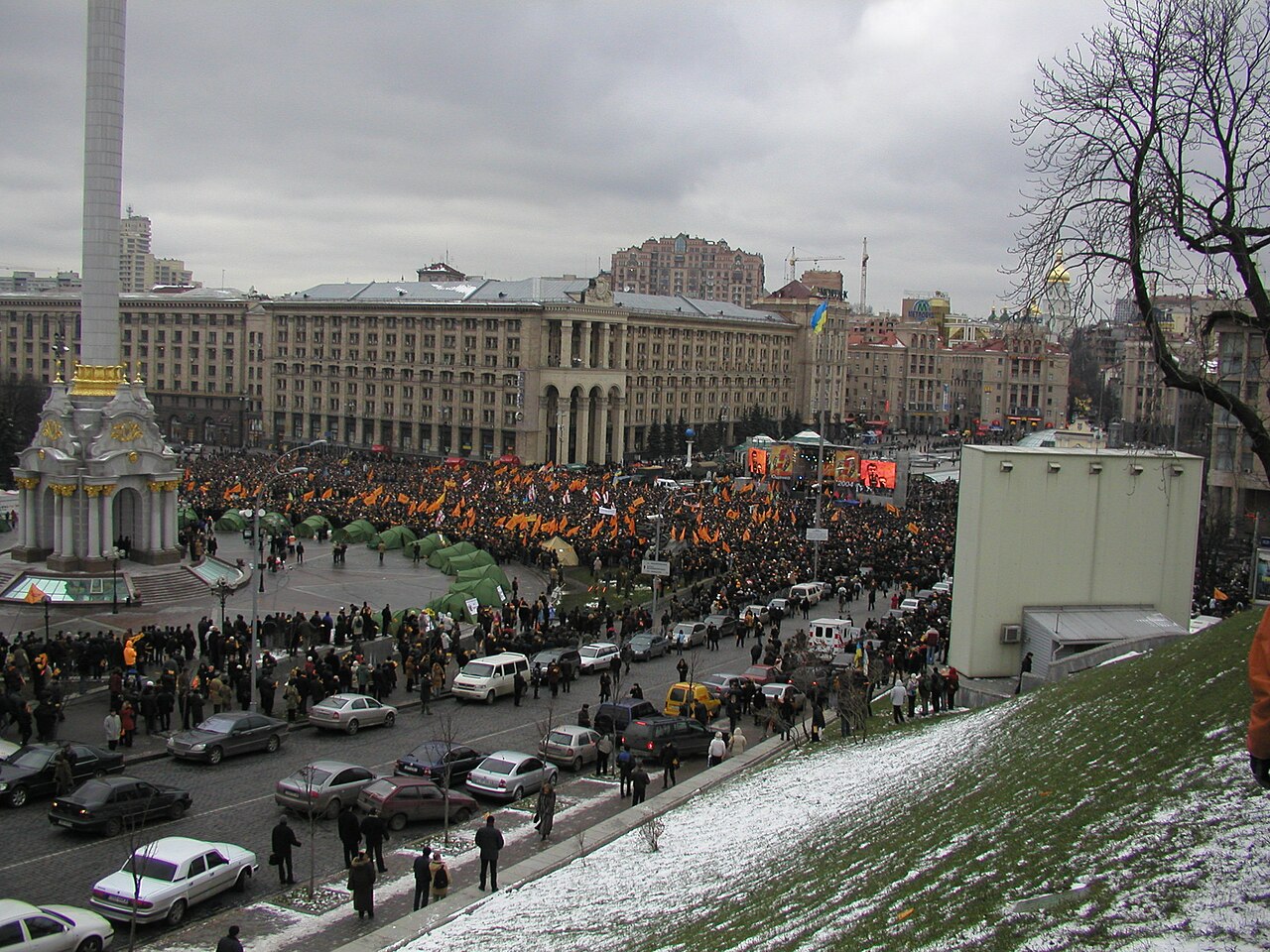
Ein entscheidendes Ereignis in der Ukraine 2004 sollte einiges ändern. Russland hatte mit einem enormen Budget in die Unterstützung Viktor Janukowytschs bei der ukrainischen Präsidentschaftswahl investiert. Doch die Versuche, die Ergebnisse zu fälschen, lösten Massenproteste aus, und der „pro-westliche” Kandidat Viktor Juschtschenko gewann. Die Schlussfolgerung der Wahlniederlage war im Auge des Kremls einfach: Die Niederlage wurde nicht von ukrainischen Wählern, sondern durch westliche NGO-Gelder verursacht.
Von diesem Moment an hatte die Kreml-Propaganda ihren Rahmen: ausländisch finanzierte Zivilgesellschaft ist gleichbedeutend mit ausländischer Einmischung. Legitimer Widerspruch im Land wurde damit per Definition unmöglich.
2012 kehrte Putin schließlich in den Kreml zurück – und in ein Land in Aufruhr. Die gefälschten Dumawahlen vom Dezember 2011 hatten Zehntausende auf die Straße gebracht. Es waren die größten Proteste in der postsowjetischen russischen Geschichte. Sie riefen „Russland ohne Putin”. Putins Reaktion bestand jedoch nicht darin, auf die Vorwürfe einzugehen. Stattdessen begann er die Protestorganisatoren zu identifizieren — und ihnen die Luft abzudrehen. Das Bundesgesetz Nr. 121-FZ wurde am 20. Juli 2012 unterzeichnet, weniger als drei Monate nach seiner dritten Amtseinführung und als direkte Reaktion auf die Massenproteste.
From that moment, Kremlin propaganda had its frame: foreign-funded civil society equals foreign interference. Legitimate domestic dissent became, by definition, impossible.
Following Dmitry Medvedev’s four-year presidential interlude, Putin returned to the Kremlin in 2012. He came back to a country in revolt. The fraudulent December 2011 Duma elections had sent tens of thousands into the streets — the largest protests in post-Soviet Russian history, filling the center of Moscow with demonstrators who chanted “Russia without Putin.”
Putin’s response was not to engage with the grievances. It was to identify the organizers — and to cut off their oxygen. Federal Law No. 121-FZ was signed on July 20, 2012, less than three months after his third-term inauguration – a direct response to the mass protests
When justifying the law, the Kremlin invoked Western precedent — specifically the U.S. Foreign Agents Registration Act (FARA). The comparison was cynical. FARA regulates activities carried out on behalf of a specific foreign principal, targeting direct lobbying agents. Russia’s law was designed to control any organization that received foreign funding and commented on public affairs. The distinction was the entire point.
PART TWO: The Anatomy of a Perfect Weapon
The foreign agent law worked not through mass arrests but through what lawyers call “regulatory burden” — and what its targets experienced as slow suffocation. Its mechanisms were elegantly calibrated, and its scope was, by design, expandable.
Four Instruments of Control
Registration and labeling: Organizations that met the criteria were required to register with the Ministry of Justice and to place a prominent “foreign agent” disclaimer on every publication, website, and email newsletter. The label was not a neutral descriptor — it was a stigma, designed to destroy credibility with audiences and partners alike.
Bureaucratic exhaustion: Registered organizations faced quarterly financial reports, semi-annual activity disclosures, and annual external audits — a compliance volume designed to overwhelm the administrative capacity of small civic organizations. The paperwork did not merely burden them. It broke them.
Criminal exposure: Initial fines for non-compliance were substantial. A provision of the Criminal Code introduced up to two years’ imprisonment for “malicious evasion” of registration, which was later extended to five years. Non-compliance became not merely expensive, but personally dangerous.
Definitional vagueness: The law nominally excluded science, culture, and health from “political activity.” In practice, the definition expanded to cover virtually any public commentary on government policy.
The Chilling Effect
The most devastating feature of the law was not its penalties — it was its shadow. Organizations that had never been designated began self-censoring, refusing foreign grants, and scaling back programming. Journalists avoided sources who had been labeled. Ordinary citizens would not agree to be interviewed by a “foreign agent.” The law’s real reach extended far beyond its formal list.
Four Waves of Expansion
The law’s reach grew methodically over a decade. In 2017, in retaliation for Washington’s FARA requirement for RT America, Russia extended the designation to media outlets, immediately targeting nine U.S.-funded outlets, including Voice of America and Radio Free Europe. By 2019, individual journalists and bloggers could be designated without any organizational affiliation. In 2020, the law was extended to unregistered associations and foreign nationals residing in Russia. The final expansion came in 2022, when proof of foreign funding was dropped entirely in favor of “foreign influence” — a standard so broad that, as Human Rights Watch’s Rachel Denber warned, it could apply to almost anyone. Designated individuals were barred from running for office, teaching children, or serving on electoral commissions, with no clear path to removal.
PART THREE: The Systematic Destruction of Russian Civil Society
The law’s most consequential targets were not random. They were the organizations that constituted Russia’s independent civic infrastructure — the institutions that made accountability possible.
Memorial: “A false image of the USSR as a terrorist state”
Memorial International was co-founded by Nobel laureate Andrei Sakharov in 1989 with a single defining mission: to document Soviet-era atrocities and preserve the memory of their victims. It was designated a foreign agent in 2016. On December 28, 2021, the Supreme Court ordered its liquidation. The prosecution’s stated rationale deserves to be read in full: Memorial, the state argued, “creates a false image of the USSR as a terrorist state.” Memorial was subsequently awarded the 2022 Nobel Peace Prize. It had already been dissolved.
The Levada Center: designated two weeks before an election
The Levada Center, Russia’s only independent polling organization, was designated a foreign agent on September 5, 2016 — precisely two weeks before parliamentary elections. The timing was not coincidental. It followed the publication of polls showing United Russia’s support dropping from 39% to 31%. The designation did not cite those polls. It did not need to.
Golos: Russia’s last election monitor
Golos was the country’s only independent election watchdog. It became the first organization prosecuted under the Foreign Agents Registration Act in April 2013. It was liquidated in 2016. Its co-chair, Grigory Melkonyants, was sentenced to five years in prison in May 2025. In July 2025, the organization announced its permanent closure. Russia now has no independent election monitoring.
The destruction of independent media
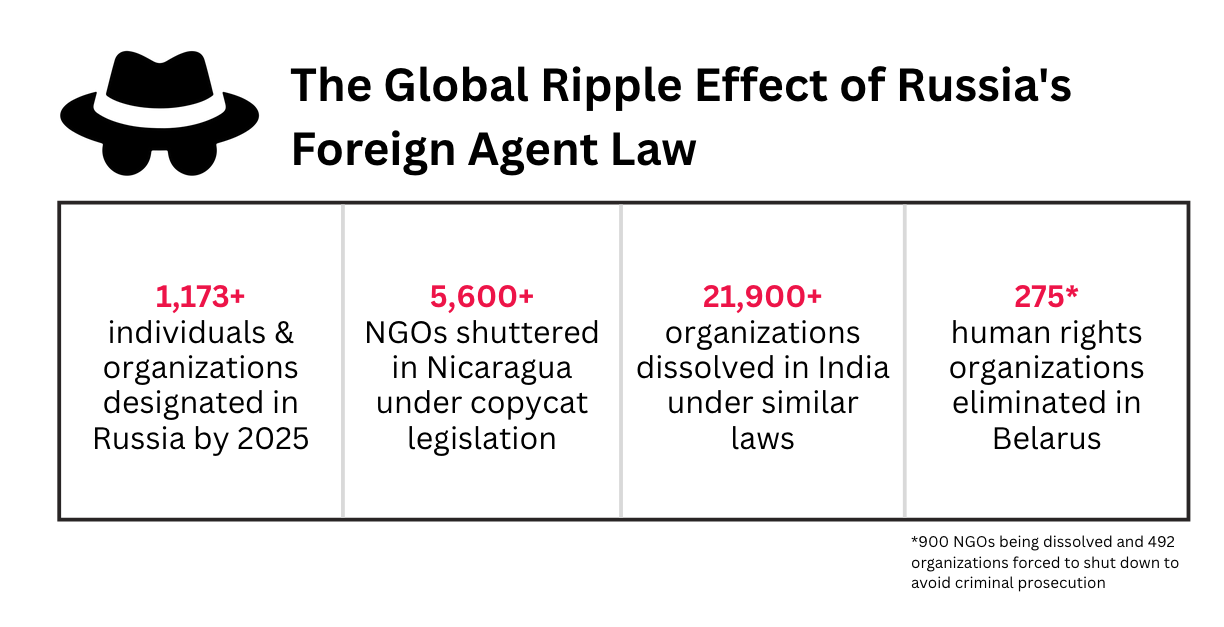
The media sector was systematically dismantled. The online medium VTimes shut down within weeks of its May 2021 designation after all advertisers withdrew. The exile platform Meduza lost nearly all domestic advertising revenue. Novaya Gazeta suspended publication following the 2022 Ukraine invasion; its editor, Dmitry Muratov was himself designated a foreign agent in September 2023. Radio Free Europe/Radio Liberty accumulated over $2.3 million in fines across more than 500 violations. By mid-2025, Russia’s foreign agent registry contained over 900 entries. Roughly one-third were media-related. One of those examples is the CORRECTIV journalist Sergey Lukashevkiy.
Sergey Lukashevkiy: Learning to Wear the Label
In 2008, Arseniy Roginskiy of Memorial and Sergei Kovalev, Russia’s first Human Rights Ombudsman, invited me to become director of the Sakharov Center — an independent museum and public platform named after the dissident and Nobel laureate. “It is a good position to stay until retirement,” Roginskiy told my 33-year-old self. Despite the drift toward authoritarianism, long-term planning still seemed possible.
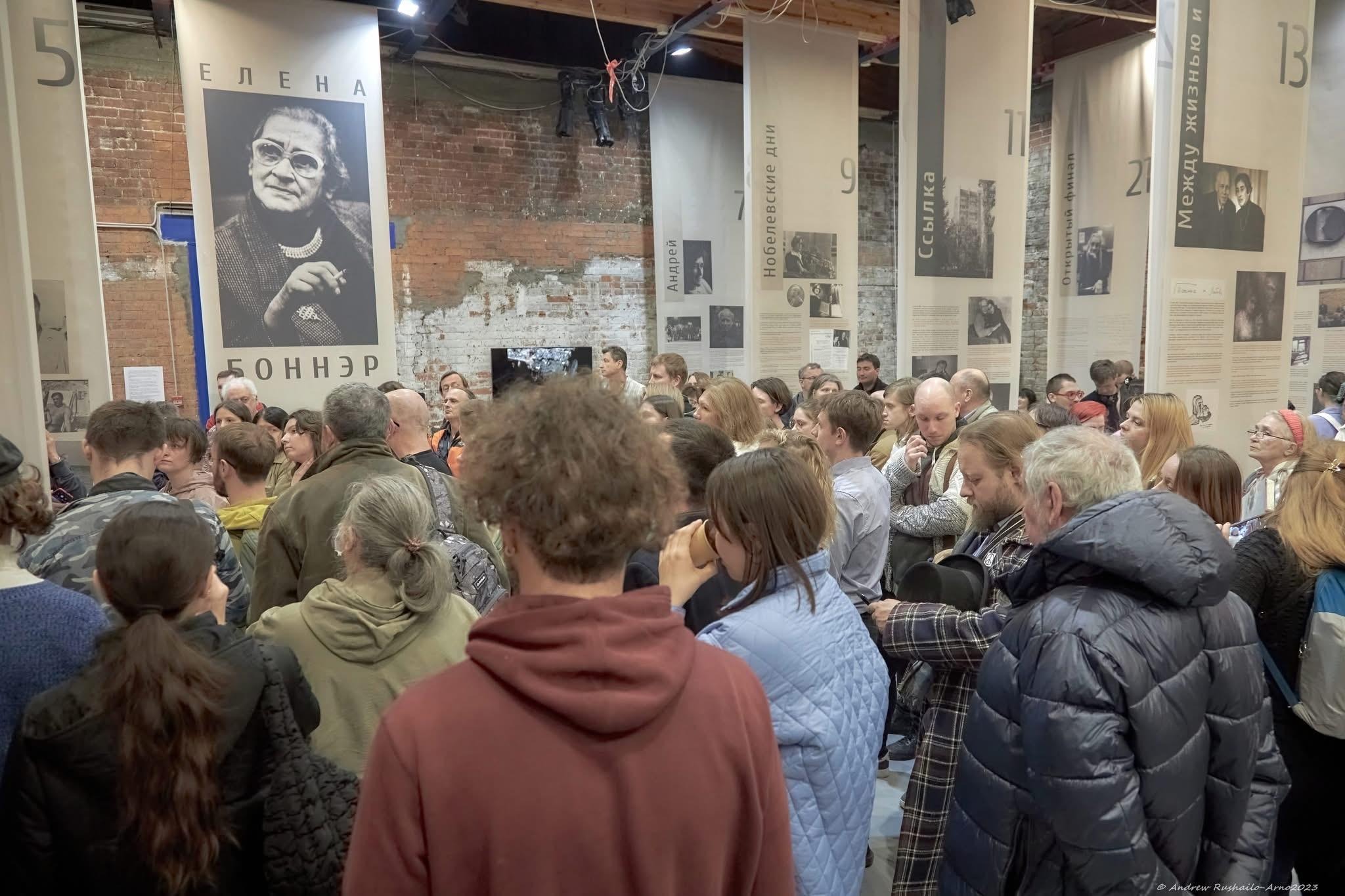
In 2011, I made the Center the main venue for the united opposition protests. By spring 2012, the protests had failed, Putin had returned for a third term, and the foreign agent law was coming. I knew we were a target — yet I still tried to convince myself nothing was predetermined. In December 2014, we were designated. The fine included a penalty for failing to report ourselves.
No matter how much you prepare, becoming a target still feels like falling into a dark pit. For me, it was also a pit filled with family memory: my grandfather arrested in 1938 on fabricated espionage charges; my great-grandparents shot at Ponary after being forced to wear the yellow star in the Vilnius Ghetto. Now I was legally required to publicly label myself the director of a “foreign agent” organization. History was tracing a deeply disturbing circle.
What followed was years of slow suffocation — unannounced inspections, mounting fines, daily anxiety. Yet our audience stayed with us. Halls kept filling.
When the full-scale invasion began in February 2022, I left Russia to keep telling the truth. In April 2022, we published a discussion of the Bucha massacres on YouTube. The response: a 5-million-ruble fine for the Center, 3 million for me personally, and eventually a criminal conviction in absentia — eight years in prison. The same sentence my grandfather received in 1939.
By 2024, the Sakharov Center had been liquidated.
Part of the Center’s team went on to work with Correctiv, launching the “Radio Sakharov” project—which, in turn, was designated a “foreign agent” by Russian authorities in 2025.
THE COPYCAT PHENOMENON: Where the Model Has Traveled
The foreign agent model has been adopted or proposed in at least 30 countries. The structural DNA is consistent across all of them: broad definitions, stigmatizing labels, crushing compliance burdens, and — crucially — the reframing of domestic civil society as a foreign threat. Below are 3 cases from Europe that show how far the template has traveled.
CASE STUDIES
Hungary — THREE WAVES — STILL ESCALATING
The EU’s pioneer of the model. Hungary’s 2017 “Lex NGO” — struck down by the EU Court of Justice in 2020 — was directly compared to Russia’s law.. A 2023 Sovereignty Protection Act established a government investigative office that has since targeted opposition politicians, international journalists and civil society organisations like Transparency International Hungary. A 2025 “Transparency of Public Life” bill would authorize an outright ban on foreign funding including EU grants. The European Parliament has described Hungary as a “hybrid regime of electoral autocracy.” Péter Magyar, Hungary’s incoming prime minister framed the bill as part of an authoritarian project, urging voters to choose between East and West, propaganda and honest discourse, and corruption and clean governance.
Slovakia — ENACTED APRIL 2025
Slovak civil society fears a chilling new era as the NGO transparency law passed in April 2025 is being implemented. When first introduced in early 2024, the draft bill required NGOs receiving more than €5,000 from foreign sources to label themselves as “organisations with foreign support“. Approved in April 2025, the legislation abandoned earlier plans to label NGOs as “foreign agents” but retained vague, punitive requirements that critics say enable state surveillance and harassment.
Slovakia’s crackdown on NGOs echoes Putin’s playbook; it shares its DNA with his infamous 2012 foreign agents law. Prime Minister Fico, who visited Putin in Moscow in December 2024, declared upon returning to power that the era of NGOs ruling this country is over.
Serbia — STALLED — NOT ABANDONED
MPs from the pro-Russian coalition partner — Movement of Socialists, headed by Deputy Prime Minister Aleksandar Vulin — submitted the Bill on the Special Registry of Agents of Foreign Influence to Parliament in November 2024. Vulin was sanctioned by the U.S. in 2023 for facilitating Russian intelligence activities.The European Economic and Social Committee stated the draft law is incompatible with the fundamental values of the European Union and poses “a serious and direct threat to civil society organisations.” The bill remains stalled due to Serbia’s ongoing EU accession process — Brussels has made clear that legislation perceived as suppressing civil liberties could jeopardize progress.
Why Autocrats Choose This Law Above All Others
The foreign agent law succeeds where cruder instruments fail because it operates at the level of legitimacy rather than force. It does not need to arrest journalists — it makes them unemployable. It does not need to ban organizations — it makes funding their work impossible. It does not need to silence dissent — it poisons it at the source, by attaching a label that translates, in the public mind, as “traitor.”
It also provides deniability. When an NGO collapses under the burden of compliance costs, no one is responsible. When a journalist loses their audience because they are legally required to announce themselves as a “foreign agent”, the state has done nothing wrong. It has merely required transparency.
And it scales. A relatively simple amendment to existing non-profit law is sufficient. No specialized infrastructure is required. No new security services. No new courts. The model can be deployed in Budapest or Managua, in Belgrade or New Delhi, with minimal adaptation. Which is exactly what has happened.
What began as Vladimir Putin’s response to a domestic protest movement has become the preferred legal instrument of governments seeking to neutralize civil society by reframing it as a foreign threat. The graffiti sprayed on Moscow NGO buildings the night before the law took effect in 2012 has, in a sense, become official state policy in dozens of countries. The only thing that has changed is the handwriting.
– – – – – – – – – – – –
Editing: Minou Becker & Finn Schöneck
Fact-checking: Minou Becker
Illustration: Viera Zuborova

