This special series draws on CORRECTIV.Exile’s network of journalists and professionals who document, despite continuing pressure, how authoritarian leaders learn from one another and accelerate democratic backsliding worldwide. We aim to reveal patterns: Hungary’s methods replicated in Poland, Russia’s “foreign agent” laws spreading to Georgia and Serbia. This is not an isolated crisis but a coordinated global shift — a warning before legal becomes irreversible, before democracy becomes memory.
Three weeks before he will swear the oath of office for the third time, designated Czech prime minister Andrej Babiš’s company buys a port. Not a whole port, but an ammonia terminal on Rotterdam’s waterfront for 290 million euros, with fertilizer raw material flowing in from the sea. In the same weeks, the company pays its owner a dividend. Five billion Czech crowns before tax, 4.25 billion after: This equates to about 170 million euros, or, on a prime minister’s salary, twelve centuries of work. Then he places the shares in a trust for his three children, and on December 15th, 2025, the cabinet is sworn in.
Nobody has broken a law. Keep that sentence in mind. It will be true at every step of this story, and that’s why it matters.
That same year, a German “ZEIT”-documentary listed what Donald Trump’s second term brought his family: crypto ventures, a jumbo jet from Qatar, and a lawsuit against his own government for presumed tax relief. Its title posed a question: “Kleptokratie made in USA?”. This chapter asks a question that connects both cases and concerns us directly: what happens to a democracy when its prime minister is, legally, its largest recipient of public funds – and how many European countries have already experienced this firsthand?
Kleptocracy comes from the Greek for “rule by thieves.” It describes a state whose institutions enrich the people who run it. Unlike bribery, it often breaks no laws: the rules are (re)written so money flows to those in charge.
I. Why Powerful Men want the State
In 2012, a year after founding his political movement, Andrej Babiš explained to his employees why he, a billionaire, wanted a seat in government. In the company magazine, he wrote that confronting the systemic corruption of Czech politics and media “unfortunately cannot be done otherwise than by entering politics”. Silvio Berlusconi said much the same in 1994, Bidzina Ivanishvili in 2011, and Donald Trump in 2015: “I’m really rich,” he told the crowd at his campaign launch. The voters understood: a man with that much money, they reasoned, cannot be bought.
The claim is always the same: wealth makes a politician incorruptible. However, the record states the opposite. This is illustrated in each case presented in this chapter by four recurring roles a rich man plays as he enters politics. Understanding these roles is the key to understand how kleptocracy is set up.

Bitte nehmen Sie sich einen Moment Zeit.
Nachrichten und Recherchen sind unerlässlich, damit Sie sich eine Meinung bilden können. Aber die derzeitigen Bedrohungen der freien Presse und der Medienlandschaft sind alarmierend.
Wir fordern die Bundesregierung auf, Pressefreiheit und die Medienvielfalt in Deutschland umfangreich zu schützen. Machen Sie mit.
- The Landlord: The rich man doesn’t rob the house; he moves in. A fortune made in the 1990s from privatization, state trading firms, and public contracts is only as safe as the government that tolerates it. Every election, every new prosecutor, every tax audit can take it away. The cheapest insurance is to hold the office yourself. Berlusconi entered politics as his debts and legal troubles peaked; Babiš as the police looked into one of his subsidies and the tax office looked into his bonds. The rich man arrives promising to clean up the state. What he actually does is move into the mess. The tell: money moves in the weeks around an election — because the rules that bind a candidate are not yet the rules that bind a prime minister. And a dividend paid out before taking office or a port acquired during the transition period is thus secured and safe before taking office and before the state can take control of his assets once he is in office.
- The Paymaster: Once inside, he has to pay the people who keep him there, which does not include the voters. It means paying the small coalition: a party, the company’s managers, a few loyal officials. They are paid in jobs, contracts, and subsidies rather than in public goods like roads and schools, because private rewards buy loyalty, whereas public ones do not. Earlier chapters showed how autocrats cultivate loyal businessmen into oligarchs who make these payments on their behalf, so that the money never appears in party accounts. The businessman-politician needs no oligarch: his company employs the coalition, and the state pays his company. The tell: the people who approve the money and the people who receive it share a payroll.
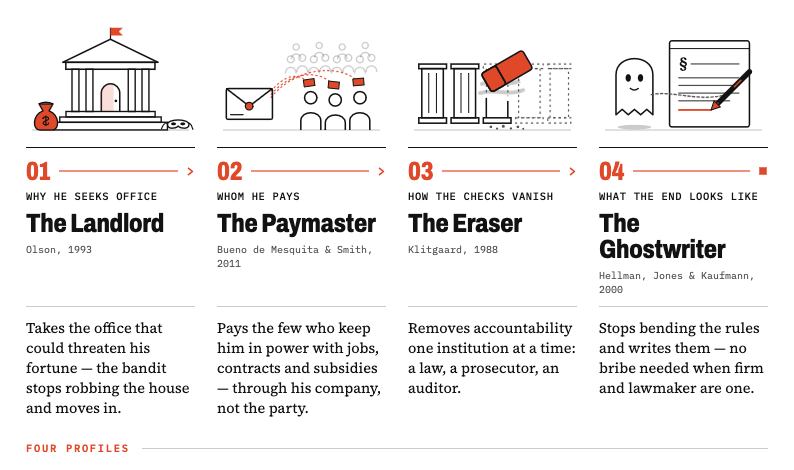
What it shows: Four theoretical roles from political science, each describing one stage of how a wealthy man uses the state: why he seeks office (the Landlord), whom he pays to keep it (the Paymaster), how the checks on him disappear (the Eraser), and what the end state looks like (the Ghostwriter). Each profile gives the motive, the method, and the sign to watch for.
- The Eraser: The business man already has the two things corruption needs: the biggest firm in a market the state pays into, and a government that writes the rules for it. The only thing in his way is accountability: courts, auditors, paying agencies, public registers, a parliament willing to use them. So he “rubs” them out one at a time, and each person that disappears without consequences makes the next one easier to remove. The tell: an EU inspection, a ministry demanding repayment, or a trial—all of these are quietly dropped.
- The Ghostwriter: The last stage needs no evasion. When the firm and the lawmaker are the same person, nobody has to bend a rule; they rewrite it. The conflict-of-interest law is amended, and the amendment fits one man exactly. The tell: the law changes in the first year of a new government, and the person it protects is the one who tabled it.
II. What Impunity looks like
Corruption stories are usually told in numbers, and numbers are easy to forget. However, people remember the absurd details, and in them lies the evidence. Each following example shows that the businessman-politician fears no consequences. On the contrary, the examples show him benefitting from impunity. Across Europe, three kinds of impunity recur, each sending a message to a different audience. The first is the display, aimed at the public: I am untouchable.
- The Display: “I am untouchable”: The first kind is wealth that nobody bothers to hide. Near Viktor Orbán’s home village stands an estate with a palm house, underground corridors, roads heated against snow, and a small private zoo accommodating zebras and antelopes. It is registered to his father. A document obtained by Direkt36 shows a nine-million-euro building project paid for by Orbán’s childhood friend, Lőrinc Mészáros. Orbán always said it was his father’s farm. The former prime minister lost power in April and the new government has promised to start its asset investigations there. Four of the zebras died over the winter, three of them from the cold; the police opened an animal-welfare investigation into how the animals were kept – not a corruption one.
Similarly, in Bratislava, Robert Fico spent most of his thirty years in politics without declaring a home. The press called him “the homeless prime minister”. He lived, rent-free, in a developer’s luxury flat; the developer was later convicted of tax fraud. Ficos neighbor across the hall was Marián Kočner, who was twice acquitted of ordering the 2018 murder of journalist Ján Kuciak and his fiancée, and is in prison for forgery. Fico himself was never investigated. His defense minister, Robert Kaliňák, lists six cars and four motorcycles, including one custom chopper worth 190,000 euros, as gifts from an Arab sheik. However, there is no information available regarding Kaliňák’s official sources of additional income. - The dodge: “your rules are furniture”: The second kind is the dodge, aimed at the institutions: the rule is obeyed on paper and emptied in practice. In France, Marine Le Pen’s bodyguard was on the European Parliament payroll as a “parliamentary assistant”, in a scheme that led to her embezzlement conviction. In July, the Paris Court of Appeal upheld that conviction. She is running for president anyways. In Italy, the Lega owes the state 49 million euros its founder and treasurer stole from electoral reimbursements and is repaying it at 600,000 a year — a process that will take roughly eighty years. And when the law does act, it tends to arrive late or leave empty-handed. The speaker of the Cypriot parliament was filmed offering to help a fictitious Chinese criminal buy an EU passport; he resigned, the passport scheme died, and in February a court acquitted him, two votes to one, among other things because the film was not admitted as evidence. In Germany, a former CSU deputy was convicted last year of passing on Azerbaijani money to colleagues — eight years after the scandal came out — and received a nine-month suspension sentence. Azerbaijan’s government used caviar as its standard gift to European politicians who came to Baku it hoped to influence; the usual portion was two kilograms.
- The rescue: “loyalty is repaid”: The third absurdity and display of impunity is one leader saving another. In November 2018, Nikola Gruevski, North Macedonia’s convicted former prime minister, crossed three borders in Hungarian embassy cars and received asylum in Budapest within days. A court there refused to extradite him. He still lives in Hungary; with Orbán gone, Skopje is asking again for his extradition. Hungary reportedly did the same for Poland’s former justice minister this January. It is a reminder that none of this is a national story: autocrats rescue one another across borders, and the networks that move their money, trusts, shell companies, friendly governments, are European, not Czech.
III. Obey the Money: an Empire the Rules cannot reach
Andrej Babiš was born in Bratislava. He founded his company in 1993 as the Prague subsidiary of Petrimex, the Slovak state’s chemicals trader, where he had worked since the 1980s. Two years after founding the company, 65 percent of it was transferred to the Swiss company called O.F.I., registered in Zug, as part of a capital increase. Who actually owned O.F.I. has never been established.
From that base, he built the largest agrochemical group in Central Europe — about 230 companies, 28,000 staff, and 212 billion crowns in revenue. To a German reader, the striking thing is how much of it lies outside the Czech Republic.
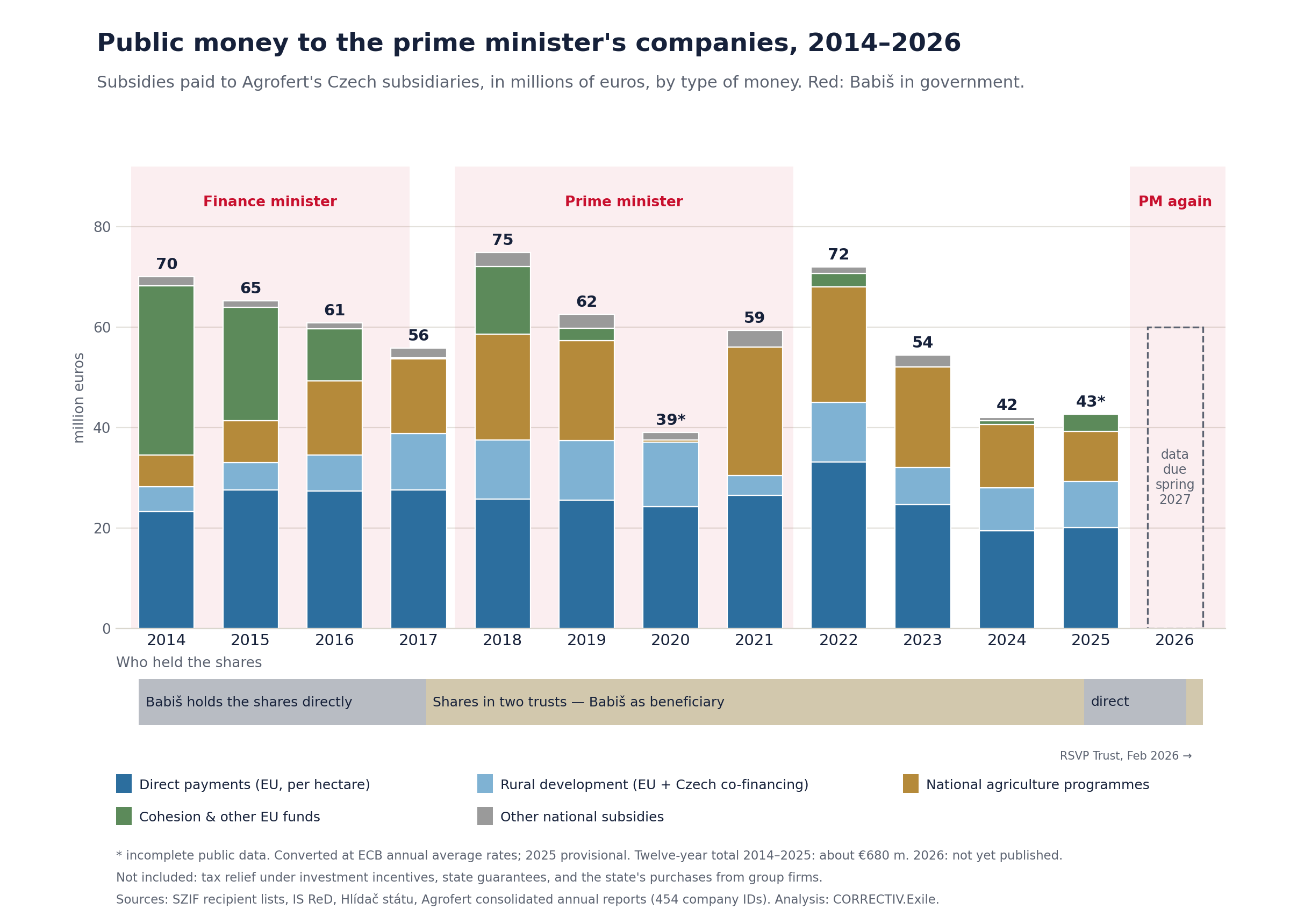
What it shows: How much public money, such as EU direct payments, rural-development grants, national programmes and other subsidies, went each year to the Czech companies of the Agrofert group, in millions of euros, from 2014 to 2025. The red bands mark the years Babis served in government; the strip beneath indicates whether he held the shares personally or through a trust. The amount stayed between 55 and 75 million euros a year regardless of either; the 2026 column is empty because the paying agency publishes each year’s list the following spring.
The empire spans over nine countries, but the public money that flows into it comes from one place. A single body pays it out: the State Agricultural Intervention Fund in Prague, the agency that distributes EU and national farm money to every Czech farmer. It answers to the agriculture minister, who answers to the prime minister. And every crown it pays is on the public record.
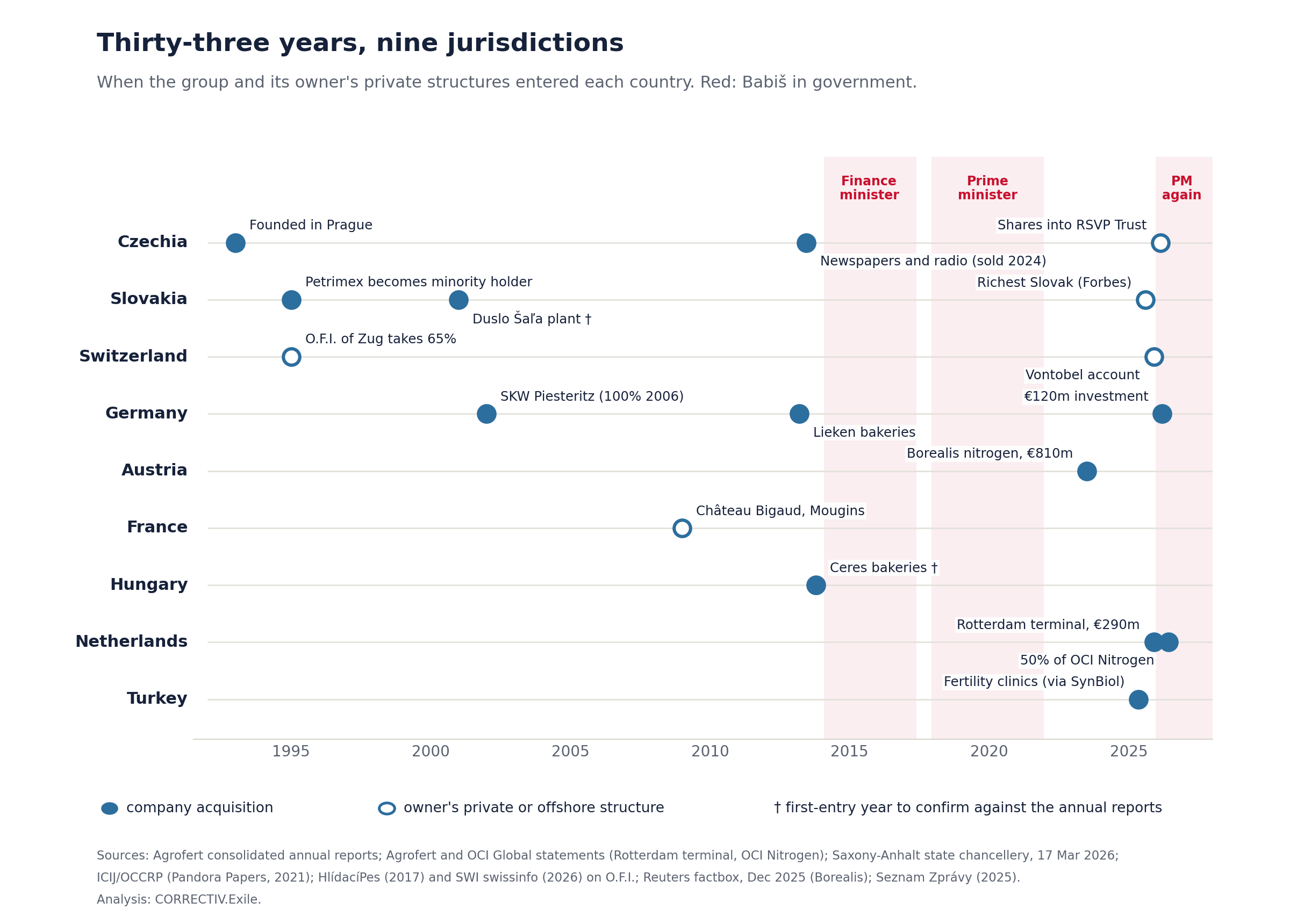
What it shows: When the Agrofert group, or its owner’s private structures, entered each of nine countries, from its founding in Prague in 1993 to the Rotterdam terminal and the children’s trust in 2025–26. Filled dots are company acquisitions; hollow dots are the owner’s private or offshore structures. The red bands mark his periods in government, so the cluster of entries made as he returned to office in 2025–26 is visible at a glance. † marks two entry years still to be confirmed from the annual reports.
We have those public records and ask them one question: how much money did the agency pay the prime minister’s companies, year by year — and did it change when he entered or left government? The agency publishes every recipient, the finance ministry lays out every grant registered and the company lists every subsidiary. We matched the three reports for the last twelve years in which Babiš was politically active.
It was the same when Babiš held the shares himself and when a trust did; the same when he was in government and when he was in opposition. In every year from 2017 to 2021 the group received more in subsidies than it paid in corporate tax. Five institutions were built to stop this. Here is what each one was, and how each one was stopped:
- The law: In 2017 parliament banned subsidies to companies owned by ministers. Six days before the relevant provision took effect, Babiš transferred his shares in the companies to two trust funds managed, among others, by a manager from the Agrofert Group.
- The prosecutor: The criminal trial over a 2 million euro EU grant allegedly obtained through a company carved out of Agrofert to qualify for funding intended for small businesses. After two acquittals were quashed, the court ordered a conviction. However, the parliament voted to uphold Babiš’s immunity, freezing the trial until the current parliamentary term ends in 2029.
- The EU auditor: The auditor is the European Commission’s own inspection of whether EU money went to a minister’s company. In 2019, it found this was true; however, Prague had never submitted these expenses to Brussels for reimbursement, so almost nothing could be recovered.
- The paying agency: In 2025 the agriculture ministry announced it would reclaim the subsidies paid to Agrofert during his first premiership — first 5.1 billion crowns, then “more than seven billion” (200–280 million euros). The agency opened two small cases, then dropped the claim four months after he returned, and kept paying the subsidies from the Czech budget.
- The European prosecutor: The European Public Prosecutor’s Office investigates crimes against the EU budget. A case opened in May 2026 against persons unknown; nobody charged, no files requested.
IV. Five Signs, before it’s too late
The Czech case is unusual only in how completely it is documented. Compared with the other cases in this series, it yields five signals that appear, in this order, wherever an owner-politician turns the state into his company’s customer. None of them is a crime. Each is visible in public records before the money actually moves.
Signal 1: The Media Comes First
In Czechia, Babiš bought the newspapers and the radio station in June and November 2013; he took a finance ministry post shortly after, in January 2014. Similarly, Berlusconi owned the TV channels before he founded his party; Orbán’s allies assembled the outlets before founding their party and then absorbed them. A businessman buying news media with no history of interest in journalism, within a year of an election, is the earliest signal there is, and the one the Czech media law of 2023 finally recognized, forcing a sale of Babiš’s media within months.
Signal 2: a trust whose beneficiaries are the family
The word “blind” is doing the work. In the Czech Republic in 2017, the trustees of Babiš’s two trusts were the company’s own managers and the “family protector” was his wife; his new Czech trust of 2026, the beneficiaries are Babiš’s three children and the trust’s statute permits him to return as administrator once he leaves public life, if the family council approves it. Wherever a trust is presented as the solution, there are three questions to ask: who are the beneficiaries, who appoints the trustee, and what happens to the shares afterwards.
Signal 3: the company’s people sit where the money is decided
In the Czech Republic that means an Agrofert board member serving on the supervisory board of the agency responsible for distributing funds to the group; a plant manager becoming the minister overseeing the ministry approves its grants and five members of parliament on the group’s payroll, all belonging to the same party. This is the signal that turns an entitlement into a system, and it is the one the commercial register shows anyone who looks. The test is not whether the people are competent. It is whether the payer and the payee share a personnel file.
Signal 4: the recovery that is announced and then disappears
In the Czech Republic the agriculture ministry announced it would reclaim “5.1 billion crowns” of Babiš’s subsidies, then “more than seven billion”; then it opened two proceedings worth millions; then, four months after the election, nothing. The legal reasoning remained unpublished. The same curve appears in Hungary under Orbán after every OLAF report, and in Serbia under Vučić after the Novi Sad station collapse. A large recovery figure announced by a minister is worth less than a small one enforced by a court; the signal is the gap between the two, and the election that sits between them.
Signal 5: the law is rewritten to fit one person
The final move is never evasion. It is legislation: a bill that confines the subsidy ban to a minister’s own ministry and cuts the recovery period from ten years to four, tabled in August 2026 by Babiš’s own coalition. Orbán’s Hungary did it with its university foundations, Fico’s Slovakia with its special prosecutor’s office. When a conflict-of-interest law is amended in the first year of a new government, the amendment is the signal.
None of the five is Czech-specific. Each is a playbook habit and a scene you will recognize the next time it plays, wherever it plays. Each leaves a trace in a register that a reader can check: a media transaction, a trust deed, a board appointment, a ministry’s press release, a parliamentary bill. That is the point of following the money the way ProPublica suggests: not to prove a crime, which is the court’s task, but to show the machine while it is still being assembled, while the warning signs are still easy to spot and the institutions that could act still exist.
We did not ask whether Andrej Babiš is corrupt. That question sits before the Czech court, which the parliament has stopped, and a French one that has not yet decided. We asked something the registers can answer: what happens to a democracy when the head of government is, legally, its largest subsidy recipient, and every institution that could interfere reports to him. The answer is in three dates. A dividend paid before the trust. A port bought before the oath. A clause in the trust deed written for after the term. One logic, no crime.
_ _ _ _ _ _ _ _ _ _ _ _ _ _ _ _ _ _ _ _ _ _ _ _ _ _ _ _
Editing: Quetzali Brandt
Illustration: Viera Zuborova