

At a glance
• Authorities test the EU’s 22,000 official bathing sites at lakes, rivers, and coastal waters only for two types of bacteria.
• Chemical pollutants are not considered when assessing bathing water quality. Experts are calling for the official monitoring program to be expanded.
• An exclusive CORRECTIV data analysis examines, for the first time, contamination in bathing waters from pollutants such as PFAS, heavy metals, and pesticide residues.
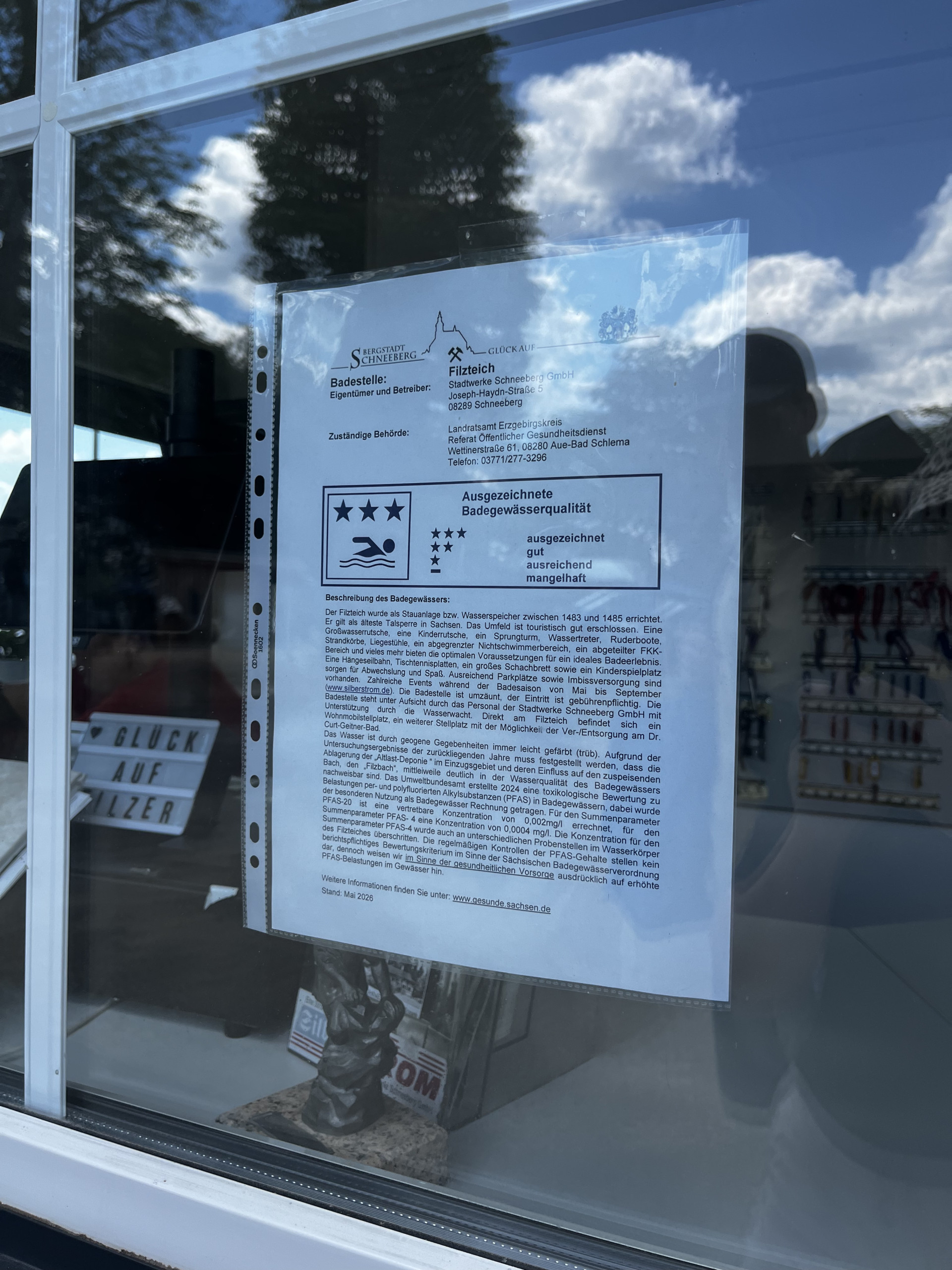
On a hot Friday in June 2026, the Filzteich bathing site near the town of Schneeberg in Saxony begins to fill with visitors around midday. Children play on slides and splash about as their parents stand knee-deep in the water. This swimming beach has received the top rating in the EU-wide rankings: “Excellent bathing water quality”, three stars – as displayed on a notice at the bathing site’s ticket counter.
This, despite the Filzteich water being contaminated with chemical pollutants.
The public authorities in Saxony and the operator of the Filzteich bathing site have known about this for years. While the notice at the ticket counter includes fine print indicating that the lake is contaminated with harmful PFAS chemicals, only the public authorities and the company operating the bathing site at the Filzteich are aware of the full extent of the contamination. For this reason, CORRECTIV.Europe took a sample of its own to be analysed.
Clean but contaminated
A Europe-wide data analysis by CORRECTIV.Europe reveals that the Filzteich is by no means the only bathing site with water that is officially rated as “excellent” despite being contaminated with pollutants. Throughout the EU, thousands of bathing sites are polluted with an array of chemical substances.
Not all these water bodies are contaminated to the same extent as the Filzteich – nor do all of them pose a risk to the health of bathers. Yet our systematic analysis reveals a blind spot in the monitoring system for the approximately 22,000 officially designated bathing sites in the EU: The European Bathing Water Directive only requires authorities to test bathing sites for two specific types of bacteria – but not for chemical pollutants (see info box).
It has long been known that most water bodies in the EU are contaminated with a wide range of chemical pollutants. This also applies to lakes, rivers and coastal beaches, where there are thousands of bathing sites officially designated as clean.
In this investigation, CORRECTIV.Europe therefore combined data from the official bathing water quality rankings with a second dataset: the EU-wide monitoring under the Water Framework Directive. The Directive sets the standards for how authorities monitor and assess the condition of aquatic ecosystems. Water samples taken for this purpose are analysed for a much broader spectrum of dozens of chemical pollutants, including heavy metals from arsenic to zinc, pesticide residues and industrial chemicals such as PFAS. To date, however, these data have not been used to assess bathing water quality.
Explore the map below to compare bathing sites in your region or at your holiday destination: how do the authorities rate the bathing water quality? Where is swimming officially deemed safe despite pollutants being detected in the water?
Methodology of our data analysis
Our data analysis enables identification of bathing sites that are officially deemed suitable for bathing despite being located at water bodies where elevated levels of chemical contamination have been detected.
Which datasets we used
For this investigation, we combined two datasets:
1. Data containing ratings for all approximately 22,000 officially designated bathing sites in the EU, which are regularly monitored by the responsible regional authorities in accordance with the requirements of the Bathing Water Directive. The Bathing Water Directive stipulates that bathing sites must be tested for two microbial parameters.
2. Data on the chemical status of all surface waters in the EU, which are monitored in accordance with the requirements of the Water Framework Directive. The Water Framework Directive stipulates that authorities must test designated water bodies for a range of chemical pollutants among other parameters.
How we combined the datasets
The Bathing Water Directive dataset and the Water Framework Directive (WFD) dataset do not provide a common identifier. We therefore linked bathing sites to their corresponding water bodies using geographic information. Using the official coordinates of bathing sites, we spatially matched each bathing site to the relevant river, lake, coastal or transitional water body contained in the WFD dataset.
Bathing sites are identified with latitude and longitude coordinates, which we compared to publicly available geodata describing WFD-designated bodies of surface water. We considered lake and coastal bathing sites to be a match if they lay within 100 metres of the nearest WFD-designated lake or coastal water polygon; we considered river bathing sites to be a match if they lay within 50 metres of the nearest WFD-designated river line. Manual checks suggest that these matches remain >90% accurate at distance thresholds of up to 250 metres.
We nevertheless limited matches to 100 metres for polygons, which already captures a large majority of sites. We maintained an even stricter standard of 50 metres for river bathing sites to account for the greater complexity of pollution in flowing water (to avoid, for example, matching swimming sites on an upstream branch with pollution data from a downstream one). Since rivers represented by a single polyline, 50 metres already includes the distance from centre to shore.
After linking the datasets, we identified bathing sites that:
received a bathing water classification of excellent, good or sufficient under the Bathing Water Directive; and were located on a water body that failed to achieve good chemical status under the WFD because one or more chemical pollutants exceeded Environmental Quality Standards.
We then extracted information on the pollutants responsible for the failed chemical status whenever this information was available in the reporting data.
A failed chemical status does not automatically mean a health risk for swimmers
Our analysis does not determine whether bathing at a particular site poses a direct health risk for humans. When a water body receives a failed chemical status under the Water Framework Directive (WFD), it means that one or more pollutants exceed environmental quality standards established primarily to protect aquatic ecosystems and wildlife. These thresholds are not designed specifically to assess risks associated with recreational bathing. A failed chemical status, therefore, should not automatically be interpreted as evidence that swimming at a particular site is harmful to human health.
Instead, our analysis helps you identify water bodies where pollutants have been detected. Based on these data, one can conclude that a specific bathing site – or a certain number of sites in your area – is located on polluted waters.
Yet, in order to assess potential health risks for bathers, further questions need to be raised:
What levels of contamination have been detected?
What do these levels mean for human health?
In some countries (Austria, Belgium, Germany, Netherlands, Sweden, Luxemburg, Latvia and Slovenia), all bathing sites included in our data analysis are located on water bodies that failed to meet the good chemical status under the WFD. This does not mean that all bathing waters in these countries pose a definite health risk. This finding instead reflects the fact that most surface waters in these countries are chronically polluted.
The pollutants most commonly responsible for surface waters in Central Europe failing to achieve good chemical status under the WFD are mercury – largely originating from historical and current emissions associated with coal combustion and other industrial sources – and polybrominated diphenyl ethers (PBDEs), a group of brominated flame retardants that were formerly used in a wide range of consumer products before being restricted and largely phased out in the EU.
Limited availability of pollution data
One of the main limitations of the available European datasets is that most countries do not report the exact concentrations measured for chemical pollutants at the European level.
In many cases, the available data only indicate whether a water body failed to achieve good chemical status and which pollutants contributed to that assessment. The underlying measurement values are often held by national or regional authorities and are not included in the aggregated European datasets.
As a result, our analysis cannot determine how far environmental quality standards were exceeded in most cases. To be able to assess potential health implications, one would need to request the underlying monitoring results from the responsible authorities in a given region.
Different reporting years and uneven monitoring coverage
The latest bathing water classifications are based on samples collected during the 2025 bathing season. By contrast, the most recent chemical-status assessments available under the WFD vary between countries due to differing reporting cycles and data availability. Detailed chemical monitoring data specifying detected concentrations are available from only a few countries: For 2023, values are available only for Austria, Belgium, Czech Republic, Denmark, Estonia, Malta, Romania; for Germany, values are from 2021; for various other countries, the values are from even longer ago (and even within those countries, coverage is not necessarily consistent – see limitations).
For all other countries, we can only provide information on whether the monitored water bodies were polluted with one or more substances to an extent that they received a “failed” chemical status.
In addition, monitoring coverage differs considerably between countries. Not all surface water bodies are monitored equally for all pollutants. The European Commission has noted that some countries report measured data for only a subset of their water bodies. Finland, for example, has stated that measured data for Priority Substances are only available for a limited proportion of its surface waters.
As a result, the absence of a “failed” chemical status in our dataset should not automatically be interpreted as evidence that a water body is free from chemical pollution.
Spatial matching uncertainty
The Bathing Water Directive and WFD datasets were produced for different regulatory purposes and do not share a common identifier linking bathing sites to monitored water bodies.
Bathing sites are identified with latitude and longitude coordinates, which we compared to publicly available geodata describing WFD-designated surface water bodies. We considered lake and coastal bathing sites to be a match if they lay within 100 metres of the nearest WFD-designated lake or coastal water polygon; we considered river bathing sites to be a match if they lay within 50 metres of the nearest WFD-designated river line. Manual checks suggest that these matches are >90% accurate, but there is the potential for error: for example, a bathing site could be wrongly attributed to one of two equally nearby lakes. You should therefore manually verify particular sites.
Chemical pollution can vary within a water body
WFD monitoring is designed to assess the condition of entire water bodies rather than individual bathing sites.
A water body classified as chemically polluted does not necessarily have the same level of contamination throughout. Pollutant concentrations can vary depending on local conditions, proximity to pollution sources, water flows, weather events, and seasonal factors.
Therefore, the chemical status assigned to a water body should not automatically be assumed to reflect the exact conditions at the specific bathing site where people enter the water to swim.
Future improvements in data availability
Recent revisions of European water legislation adopted in May 2026 will require EU member states to provide more detailed chemical monitoring data to the European Environment Agency. As these reporting requirements are implemented, future analyses should benefit from more comprehensive and comparable information on chemical pollution across Europe.
Consequently, the current analysis should be regarded as a first Europe-wide screening exercise that identifies bathing sites located on water bodies where official monitoring has detected excessive levels of chemical pollutants, rather than as a definitive assessment of health risks for bathers.
But as the saying goes, it is the dose that makes the poison: Chemical contamination doesn’t necessarily pose an inherent health risk to bathers. At bathing sites where waters are tested by authorities for chemical contamination, the map shows which pollutants have been detected – but not in what concentrations.
Only a handful of countries at EU level report the precise measurement values derived from their water samples. Moreover, the data provided by member states can be extremely patchy and, in some cases, very outdated. For this reason, we chose not to include this data in our analysis (see limitations). Currently, reliable measurement values can be obtained only with considerable effort by way of individual enquiries to the relevant regional authorities.
Conversely, however, the absence of an indication of pollutants on the bathing sites map unfortunately does not exclude possible contamination. In this case, the bathing sites either couldn’t be geographically assigned to a water body (see methodology), or the water isn’t sampled by authorities in accordance with the Water Framework Directive at all. This applies especially to many small water bodies – such as the Filzteich in Saxony.
How is bathing water quality officially assessed?
For the official assessment of bathing water quality, the EU Bathing Water Directive requires authorities in EU member states to take water samples at designated bathing sites and test these for two types of bacteria: Escherichia coli (E. coli) and intestinal enterococci.
These bacteria are considered indicators of faecal contamination – for example, when heavy rain causes sewers to overflow or when slurry is washed from fields into streams and lakes. Furthermore, there are still sewage treatment plants discharging inadequately treated wastewater into rivers.
Anyone who swallows such contaminated water whilst bathing may suffer from diarrhoea and vomiting; in more serious cases, there is a risk of respiratory or kidney infections.
The European Environment Agency (EEA) publishes an annual overview of bathing water quality in the EU. According to the latest report, based on measurements from the 2025 bathing season, 96 per cent of bathing sites meet the minimum requirements and 85 per cent even received the “excellent” rating.
A gap in the monitoring system
Water quality data is collated by the European Environment Agency (EEA). The EEA emphasises that the limit values of the Water Framework Directive – data from which we used for this analysis – are designed to protect aquatic ecosystems and wildlife. The aim is to safeguard the most vulnerable species. According to the EEA, while chemical pollutants in water can certainly also be relevant to human health, this typically applies only to the consumption of contaminated fish from such waters.
Toxicologist Hans-Jörg Martin from the University of Kiel, on the other hand, sees the results of the analysis as an indication of a blind spot in the EU’s current monitoring system. He is convinced that if the monitoring scheme included chemical parameters, authorities would most likely detect chemical contamination in bathing waters – with potential health concerns for bathing guests at some sites.
Residual pollution still contaminating bathing sites
“Even though most bathing waters in Europe are rated safe for swimming, there are sites where chemical pollution can actually be a health concern for bathing guests”, says chemist Markus Große Ophoff, a member of the German environmental agency’s expert committee for assessing the relevance of trace substances. “Chemical parameters should therefore be included in the assessment of bathing water quality. This applies in particular to areas known to be affected by legacy pollution”, where potentially elevated levels of contamination with specific pollutants can be assumed.
Such legacy pollution is precisely the cause of the contamination at the Filzteich lake in Saxony. Years ago, toxic waste – tens of thousands of tonnes of paper industry sludge – was dumped into a stream that flows into the lake. Contaminated water has been seeping into the lake ever since.
“The deposits from this old dumping site” are “now clearly detectable in the quality of the bathing waters”. This is stated on the notice at the entrance to the bathing site. Nevertheless, to this day, the site continues to receive the top rating, recognised for its “excellent bathing water quality”.
Thousands of bathing sites at contaminated water bodies
Our analysis shows that the Filzteich isn’t an isolated case. Across the EU, 7,866 bathing sites that are classified as clean under the Bathing Water Directive are located at water bodies where official sampling revealed elevated concentrations of chemical pollutants.
Most of these bathing sites are in Italy, Germany, Denmark, Hungary and France.
Our European investigative network
CORRECTIV.Europe is a network of more than 500 local journalists across the continent. Through our joint data-driven investigative reporting, we promote an informed public and contribute to strengthening local democracy.
A closer look at the data reveals that in Austria, Belgium, Germany, the Netherlands, Sweden, Luxembourg, Latvia, and Slovenia, almost all water bodies whose chemical status is monitored by the authorities are chronically polluted – in fact, in most of these countries every single body of water fails to meet the requirements of the EU Water Framework Directive.
These disastrous results are primarily attributable to two types of pollutants: mercury and a group of flame retardants. These are widespread, particularly resilient and, moreover, highly harmful to health. Mercury is mainly emitted into the environment from chimneys of coal-fired power stations. Flame retardants from the PBDE group, on the other hand, were formerly used in a wide range of everyday products. Although their use has long been banned or at least severely restricted in the EU due to the health risks posed by these substances, they can still be found almost everywhere in the environment today.
“Monitoring has to keep pace with scientific findings”
In view of this widespread pollution, there are also calls from political spheres for a revision of the European Bathing Water Directive. “The monitoring of bathing waters in Europe has to keep pace with the latest scientific findings,” says Tiemo Wölken, a member of the German Social Democrats in the European Parliament and coordinator of his political group on the Environment Committee. According to Wölken, the assessment of bathing water quality should no longer “be baselessly restricted to hazardous microbial substances.”
Even the EU has reached this conclusion. Last year, it commissioned an evaluation of its Bathing Water Directive. The final report acknowledges that the Directive has “fundamentally achieved its primary objective, namely safeguarding the health of bathers in the EU – it does so, however, exclusively with consideration to two specific bacteriological parameters.” It continues, “While the public and other stakeholders have become increasingly concerned about the potential health impacts of chemical or physical hazards for recreational users of coastal and freshwater environments, policy and science have remained focused on microbial hazards.” The report concludes that “In line with the WHO Guidelines, other pollutants/parameters, besides the two bacteriological parameters currently covered by the Directive, should be considered.”
Whether the Bathing Water Directive will indeed be revised is still under discussion. When approached by CORRECTIV.Europe for comment, the European Commission emphasised that, overall, its Bathing Water Directive effectively safeguards the health of bathers. The Commission states that it is aware of the World Health Organisation’s recommendations that chemical pollutants should also be considered when assessing bathing water quality. The Commission will distribute questionnaires to EU member states “soon in 2026” to determine if common guidelines are necessary and further scientific work will continue. Its outcome will then be discussed within the Bathing Water Expert Group.
In any case, the crucial question is: at what concentration do chemical substances pose a risk to bathers?
Authorities in the Netherlands issue warnings – and even impose bathing ban
In the Netherlands, nationwide advisory values for PFAS in swimming waters have already been in place since 2024. The reasoning: recent scientific findings demonstrated that “the substances can be harmful to health at a lower exposure level.”
To toxicologist Hans-Jörg Martin, the clear guidelines in the Netherlands make sense. Exposure to these substances is already too high, he says: “They’re everywhere already. So even a tiny bit more is already too much.”
Sources of contamination: chemical factories, fire extinguishers, foam parties
In the Netherlands, the authorities are currently informing the public about elevated PFAS levels in various bathing sites. One lake has even been completely closed off due to such contamination. According to the authorities, the substances have entered water bodies in a number of ways: one lake was reportedly contaminated by a nearby chemical factory, another by fire-extinguishing foams containing PFAS and, at one public beach, foam parties were apparently the cause of contamination.
Coastal areas are deemed especially heavily contaminated; according to studies, extremely elevated levels of PFAS have been detected particularly in sea foam. Authorities in the Netherlands and Denmark therefore advise against playing with or swallowing sea foam. They also recommend showering after a dip in the sea – or at least washing your hands before having a beach picnic. For bathers planning a trip to Germany’s North Sea coast, the municipality of Borkum offers similar advice.
Increasing indications of PFAS contamination in bathing waters
Elsewhere in Germany, too, warnings are now being issued against bathing due to critical PFAS levels. In Baden-Württemberg, where high levels of PFAS contamination in the region around Rastatt and Baden-Baden have been known for a long time, authorities reported in June that contamination levels in two lakes had risen sharply.
Samples reveal additional pollutants in bathing site
The Filzteich lake near Schneeberg in Saxony is also contaminated with PFAS. This is confirmed by official samples taken from the lake, the analysis results of which were sent to us by the Saxon State Ministry for the Environment on request. These samples were taken outside the scope of EU-wide monitoring after authorities became aware of the nearby site contaminated with legacy pollution. In response to an enquiry from CORRECTIV.Europe, the Saxon Ministry of Health stated that recent investigations carried out in spring 2026 and over the past two years have revealed isolated cases of elevated PFAS levels in the lake. For the group of four particularly harmful PFAS substances, a level which in the past had been recommended by the German Environment Agency was exceeded at some monitoring stations; for the larger group of twenty PFAS substances, however, the detected levels remained below the thresholds defined by the Agency.
Public utilities company not willing to publish test results
The operator of the bathing site, public utilities company Stadtwerke Schneeberg, has taken water samples from the actual bathing site – but has not published the findings. Bathing at the site is “harmless”, the managing director told the Freie Presse in May 2023. “Unless, of course, someone were to drink two litres of water from the Filzteich.”
The findings of this “in-company monitoring” were apparently submitted “voluntarily” to the Erzgebirgskreis public health authority. Neither the authority nor the operator was willing to disclose the measurement data.
This is why we collected our own water sample from the Filzteich bathing site. Laboratory analysis revealed: When considering the PFAS-20 total, the levels found in our sample remained below a level recommended some years ago by the German Environment Agency (see info box). However, if the stricter Danish guidelines are applied, our sample exceeds the guideline value by almost tenfold. Most crucially, the levels of two particularly harmful PFAS substances were significantly elevated in our sample: PFOA at 0.15 micrograms per litre and PFOS at 0.12 micrograms per litre.
We asked both the responsible district office and the operator of the bathing site to comment on our test results. Both replied that they were unable to respond in substance before the editorial deadline.
PFAS in bathing waters: Where do which guideline values apply?
Unlike in the Netherlands and Denmark, there are no nationally applicable guideline values in Germany that authorities can use to assess PFAS contamination in bathing waters.
Back in 2024, the German Environment Agency (UBA) – Germany’s highest environmental authority – already addressed the question of the concentrations at which PFAS in bathing water become hazardous. In a letter at that time to the joint federal-state working group on bathing waters, the UBA recommended maximum levels of 2 micrograms per litre for the PFAS-20 total and 0.4 micrograms per litre for the PFAS-4 total.
Both figures are considerably less stringent than the guideline values applicable in Denmark and the Netherlands. Upon enquiry, the UBA declined to publish its assessment from that time “so as not to disseminate information that may be out of date,” stating that the discussion had not yet been concluded and further investigation within the framework of interdisciplinary studies was necessary “to obtain a sound basis for assessment in this area.”
In the German federal state of Baden-Württemberg, on the other hand, authorities used a value determined in the neighbouring state of Bavaria as their guide – even though this recommendation is based on values only around half as stringent as those recommended by the UBA and far less strict than the standards applicable in the Netherlands and Denmark.
Why is no action being taken in Saxony, even though the contamination of the Filzteich has been known for years?
“Please, let’s not cause a panic. But turning a blind eye isn’t a solution either”
The Saxon State Ministry for Social Affairs, Health and Social Cohesion states that it is “agreed across all authorities that a waste management plan for the dumping site is the only way to permanently eliminate the source of contamination.”
However, remediation of the contaminated site would cost an estimated 12 million euros. This is according to the response from the state government to a parliamentary question posed by MP Wolfram Günther (Greens). Günther, Saxony’s former Environment Minister, says: “Please, let’s not cause a panic. But turning a blind eye isn’t a solution either.” The authorities are overburdened, he says. “The districts simply don’t have the resources to tackle these problems properly, so the issue gets put on the back burner. We cannot leave those responsible at the local level to deal with this alone.”
“Stricter regulation of critical substances”
The issue should simultaneously be addressed at EU level, Günther demands, as it isn’t only about cleaning up residual pollution like at the site in Schneeberg – it should also be ensured that more pollutants aren’t constantly being released. As a first step, Günther is therefore calling for “stricter regulation of particularly critical substances, such as PFAS”, and for “holding industry to account.”
At the Filzteich swimming beach, a woman stands ankle-deep in the cool water. In front of her is a small slide, next to which her child is playing and splashing about. She hasn’t seen the notice at the entrance of the swimming site referring to the elevated PFAS values. “But even that wouldn’t stop me from coming here to swim,” she says – the lake is just too beautiful for that. She plans to look into these chemicals later though, since she’s never heard of them. She then says something that several swimmers mentioned while talking to CORRECTIV.Europe: If there were something wrong with the Filzteich, she trusts that those in charge would take appropriate action.
Update, July 6, 2026
After this article was published, we received responses to our inquiries from the municipal utility company of Schneeberg, which operates the Filzteich lakeside beach, and from the responsible district administration of the Erzgebirgskreis. Both stated, using identical wording, that the PFAS levels measured in our sample were “below the guideline values recommended by the German Environment Agency (Umweltbundesamt),” and that “therefore no health risk is assumed.” The management of the Schneeberg municipal utility company further stated that they saw “no reason” to comment on the fact that the PFAS-4 levels measured in our sample exceed the Danish guideline value for PFAS-4 in bathing waters by nearly a factor of ten. “We follow the assessment and evaluation of the competent authorities, based on German regulations and guideline values.” The Erzgebirgskreis district administration likewise said it had “nothing to add” to the assessment of the German Environment Agency.
Text and research: Lilith Grull, Marius Münstermann, Frida Thurm
Data: Rose Mintzer-Sweeney
Editors: Martin Böhmer, Gesa Steeger, Justus von Daniels
Design: Mostafa Negm
Fact-checking: Martin Böhmer, Johannes Gille, Gesa Steeger


