

“Nowhere to Exist“ is a report by CORRECTIV.Exile × Kite Runner. The report “Nowhere to Exist” is based on five witness testimonies that were corroborated by reports from Human Rights Watch, Amnesty International, the Afghan LGBTQ+ Organization (ALO), as well as official European government and BAMF data.
Contributors/ Authors: Minou Becker, Qais Alamdar, Shahzad Mudasir, Somaia Walizadeh, Sabine Küper-Büsch, Viera Zuborova.
The Architecture of the Problem

Bitte nehmen Sie sich einen Moment Zeit.
Nachrichten und Recherchen sind unerlässlich, damit Sie sich eine Meinung bilden können. Aber die derzeitigen Bedrohungen der freien Presse und der Medienlandschaft sind alarmierend.
Wir fordern die Bundesregierung auf, Pressefreiheit und die Medienvielfalt in Deutschland umfangreich zu schützen. Machen Sie mit.
The Taliban’s return to power in August 2021 intensified a persecution that predates it. Same-sex conduct has long been criminalized under Afghan law, but the Taliban’s interpretation of sharia extends penalties to flogging and execution. In January 2026, a new penal code prescribed the death penalty for what it termed “habitual sodomy.” The formal law, however, is only the most visible layer of enforcement.
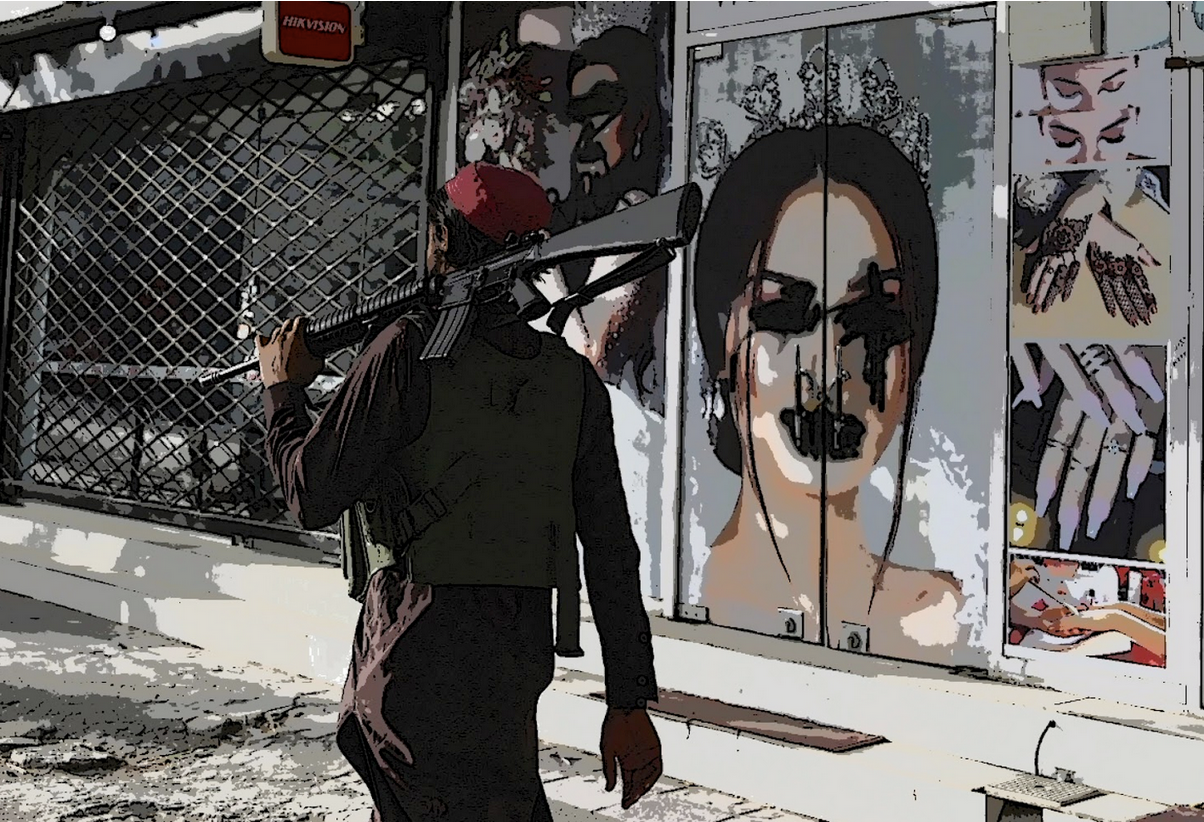
What the testimonies in this report reveal is a deeper architecture — one that does not depend on the state alone. Digital surveillance, through the routine confiscation and searching of phones and social media accounts, allows the Taliban to trace relationships, identify individuals, and build cases. Community reporting, in which neighbors and acquaintances become informants, distributes enforcement beyond the security apparatus into everyday social life. Cultural prohibition — of music, dance, gender-nonconforming dress — turns visibility itself into a vulnerability. And for Hazara individuals, already subjected to ethnic and sectarian persecution, these risks compound in ways that are not simply additive. They multiply.
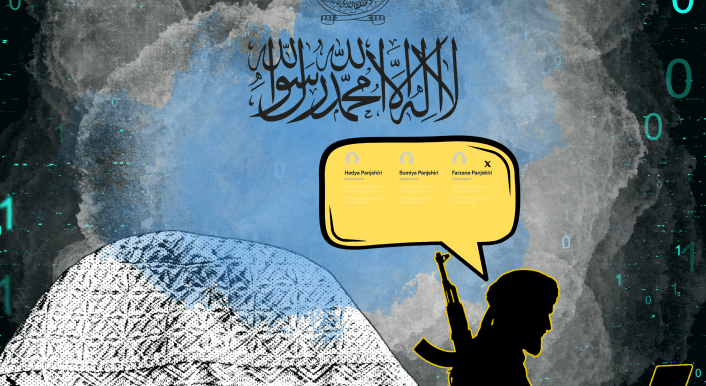
The report coins a term for this: the architecture of erasure. It is a structure in which queer and trans Afghans face persecution simultaneously from the state, the community, the family, and the digital sphere — with no sphere of life left unmonitored, and no private space of safety remaining.
“Despite everything, I keep dancing. If I stop, I would already be dead.”
— Vantace, 15, Kabul
The Family as a Second Enforcement Authority
One of the report’s most significant findings concerns the role of the family — not as a refuge, but as a secondary site of the same persecution the state enforces.
In at least four of the five cases documented, family members replicated Taliban-style prohibitions in the home: through beatings, confinement, psychological control, and the withdrawal of any right to exist as oneself. For some individuals, the family absorbed external pressure without rejecting them — but in doing so, the home itself became a site of ambient threat. For others, family members became active enforcers, using violence and surveillance to control behavior they feared would attract state punishment or dishonor.
“My home was a prison. I was beaten, cursed, humiliated. They called me a stain. They said I had taken away their honor.”
— Idris, 19, Location undisclosed
The Transit Zone: Pakistan as a Wall, Not a Gateway
Leaving Afghanistan does not end the danger. The report documents how Pakistan, the primary destination for Afghan refugees, functions not as a place of refuge but as what the investigators call a “holding zone” — defined by legal precarity, exposure, exploitation, and the ever-present threat of forced return.
Since September 2023, Pakistan has deported approximately 1.7 million Afghans. Of those, nearly 779,000 were returned in 2025 alone. These deportations have continued despite sustained warnings from the United Nations and Amnesty International that returning individuals to Taliban-controlled Afghanistan violates the principle of non-refoulement — the foundational norm of international refugee law that prohibits returning people to countries where they face persecution, torture, or death. The continuation of these deportations is not an administrative oversight. It reflects a sustained policy decision in the face of documented and foreseeable harm.
For queer and trans Afghans in Pakistan, the specific vulnerabilities are compounding. They lack legal status. They are exposed to police harassment. They face exploitation in shelter systems that were not designed with their particular risks in mind — a gap the report illustrates through one testimony of sexual exploitation within an NGO-supported shelter, which deteriorated after a private company assumed management. When the individual refused the demands made of her, she was expelled and slept in a public park. She was subsequently deported to Afghanistan, detained, and subjected to torture.
“No human being, including myself, should have to go through this”
— Ada, 20, Pakistan
The report’s finding here is blunt: no harm occurred despite the shelter’s existence. It occurred within one. The protection architecture failed not in the absence of structures, but in the absence of accountability within them.
Iran, the route taken by another of the report’s subjects, offers no better outcome. He was deported by Iranian authorities in 2025 after three years of harassment and legal invisibility, and returned to Afghanistan homeless and in hiding.
For those who cannot leave Afghanistan at all — two of the five individuals in the report — immobility is itself a form of violence. The enforced impossibility of movement, of escape, of life beyond survival is not the absence of harm. It is harm in its most complete form.
Germany: The Paradox of Recognition Without Protection
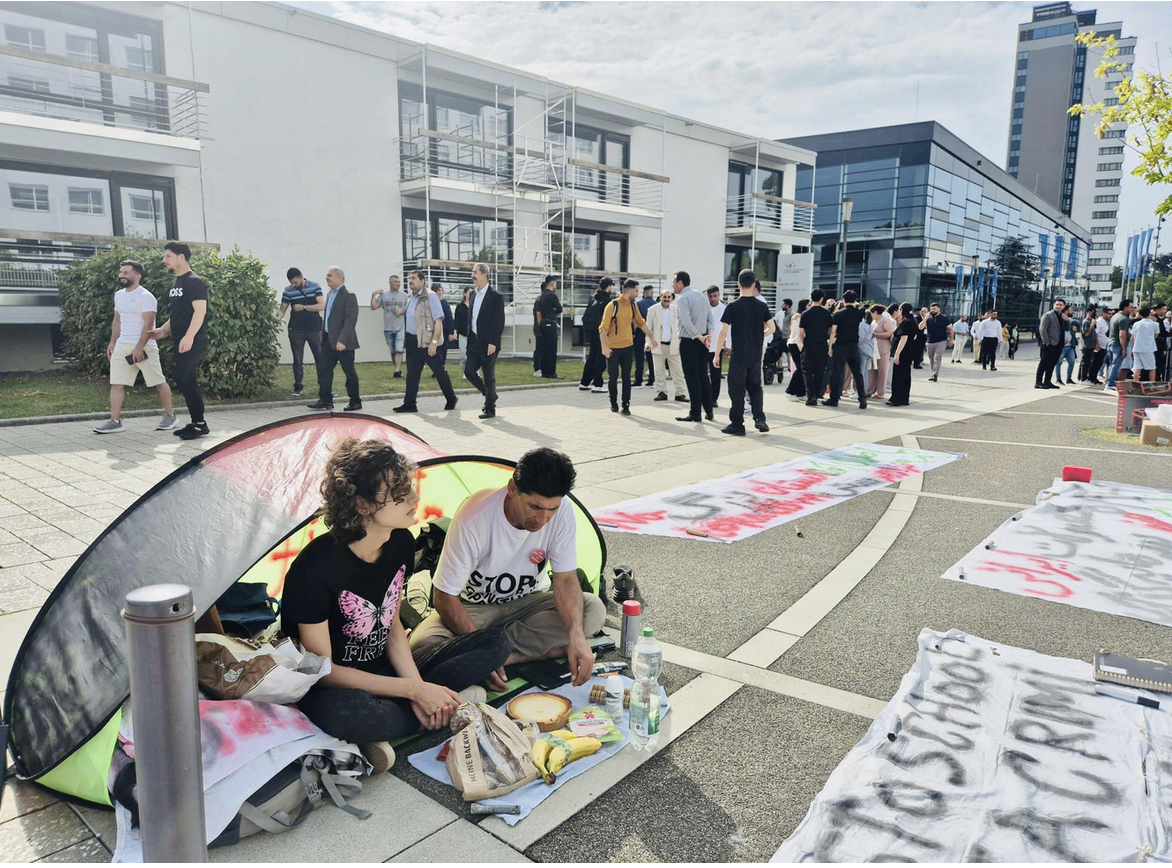
Germany represents a different kind of failure — quieter, more procedural, but no less consequential. For those who reach it, Germany offers the first moment of physical safety. The German legal framework formally recognizes persecution based on sexual orientation and gender identity as grounds for asylum. And yet the report documents a systematic retreat from the infrastructure that makes that recognition meaningful in practice.
The federal admission program launched in 2022 by then-Foreign Minister Annalena Baerbock (The Greens) was the first to explicitly include sexual orientation and gender identity as admission criteria. The program was intended to allow up to 1,000 people per month to enter; actual arrivals, however, remained below that target. Furthermore, the traffic-light government failed, before the change of government, to fly in all Afghans who had been promised admission to Germany to be flown in. As a result, after the black-red coalition took office, roughly 2,300 Afghans with admission promises were still waiting in Pakistan. For about half of them, the government under Friedrich Merz (CDU) revoked those promises. The reason: the coalition had agreed to phase out humanitarian admission programs as far as possible. Instead, the government offered financial support to refugees if they withdrew from the admission procedure. Hundreds of lawsuits are still pending in German courts. Some Afghans have already successfully sued for entry to Germany.
The consequences of this political decision were foreseeable. Hundreds of people who had been promised protection had already adjusted their life decisions accordingly — where they stayed, which documents they applied for, and what risks they took. Once those promises were withdrawn, these people could not simply return to their previous lives. They suddenly found themselves in a situation made even more dangerous by the asylum process itself. This is shown by an incident in January 2026.
The Taliban searched an facility in Kabul that had been part of the German admission programs and interrogated the 79 people seeking protection. They had previously been deported from Pakistan to Afghanistan despite having admission promises.
One of the report’s subjects had received a positive response to her letter to German immigration authorities while she was in Pakistan. She waited for a formal decision that never came, was deported by Pakistani authorities while that decision remained unmade, detained and tortured in Afghanistan, and then returned — again — to Pakistan, where she now waits in uncertainty.
The report identifies a structural paradox at the heart of Germany’s position: it recognizes persecution on grounds of sexual orientation and gender identity as grounds for asylum while simultaneously dismantling the structures through which people can navigate the asylum process and build lives once they arrive.
Germany currently has 88 counseling centers, 25 advocacy networks, and 56 meeting spaces for queer refugees — a network built over the years that is now being defunded. An LSVD+ project providing specialised support to queer refugees ceased services at the end of 2025. All counseling services for queer refugees in the state of Saxony have been cut. No funds have been allocated in the 2027 federal budget for independent asylum procedure counseling.
The result is not a failure of legal recognition. It is a failure of implementation — and for those navigating it, the distinction matters very little.
Conceptualizing the Problem: A Chain, Not a Series of Failures
What makes this report analytically important — beyond the individual testimonies it documents — is its insistence on treating these failures as structurally connected rather than as separate policy problems with separate solutions.
“My living situation, my private life, and my future allfeel uncertain and dark. But I am still young, and I want to live a better life and a life without fear. Regardless of where it is
— Idris, 19, Location undisclosed
The Taliban’s enforcement architecture, the family’s role as a secondary authority, Pakistan’s deportation machine, and Germany’s retreat from its own commitments are not independent phenomena. They are links in a single chain of displacement that begins with persecution and, for most of the individuals in this report, has not yet ended. Each link adapts the form of harm: in Afghanistan, it is arrest, violence, and death; in Pakistan and Iran, it is deportation, exploitation, and legal invisibility; in Germany, it is bureaucratic indifference, social isolation, and the quiet erosion of systems that were supposed to help.
The report also identifies what it calls a “visibility gap” — a finding that is methodological in form but political in implication. The individuals most in danger are the hardest to reach and the least able to speak publicly. The investigation was shaped by who was reachable, and reachability is itself distributed by the inequalities the report documents. One of the five individuals gave testimony publicly and now advocates openly; the others remain in hiding, detention, at risk, homelessness, or confinement. The voices most urgently in need of hearing are precisely those that protection systems are not designed to find.
The Barriers to a Way Out
The report stops short of proposing a policy agenda — that is not its form — but it makes the structural barriers to any solution visible with precision.
The first barrier is the continuation of deportations in violation of the principle of non-refoulement. Without enforcement of the legal obligations Pakistan — and other transit states — already hold, those obligations are, in practice, non-existent for the individuals most at risk.
The second is the absence of tailored protection for LGBTQ+ individuals within refugee support systems. Generalized protection frameworks were not designed for targeted persecution and fail to protect people facing it in specific, predictable ways.
The third is the withdrawal of political will in receiving countries. Where formal commitments were made and then revoked, the consequences were not abstract. They were, in the cases documented here, detention and torture. A protection framework that can be canceled by a change of government is not a protection framework. It is a promise with an expiry date.
The fourth is the erosion of the civil society infrastructure that enables protection in practice. Legal recognition of persecution as grounds for asylum means nothing if those who need it cannot access counsel, navigate bureaucratic processes, or find community after arrival.
The fifth — and perhaps most difficult to address — is the extension of control beyond borders. Multiple testimonies indicate that the surveillance, social pressure, and enforcement mechanisms of Taliban-era Afghanistan do not disappear at the border. They can persist in diaspora communities, continuing to shape what is possible — and what is safe — for queer and trans Afghans who have technically reached a country of refuge.
When everyday life becomes impossible
Nowhere to Exist is not, at its core, an investigation into individual cruelty. The harm it documents is systemic. It arises not from the malice of any single actor but from the interaction of multiple systems, each operating according to its own logic, none of which was designed to account for the specific situation of a queer or trans Afghan navigating them all at once.
The five individuals at the center of this report wanted ordinary things. To dance. To have a small home and honest work. To be treated as a human being. To reach a safe country. To tell stories and break taboos. None of these is an extraordinary demand. What is extraordinary is that the systems arrayed around them — of law, enforcement, border control, asylum procedure, and political commitment — combined to make even these most ordinary things impossible.
——————
Redigat: Lena Köpsell
