
Dossiers of Abuse
The story of organised crime in the Vatican
Chapter 1
What the Vatican knew
The first big revelation came to light in 2002, in the USA. An investigative team at the Boston Globe showed the true magnitude of abuse perpetrated by priests. The number far exceeded individual cases: today, there are around 200 known offenders in Boston alone. Using internal documents, the journalists were able to prove how the local church leaders had dealt with the perpetrators – how cardinals were systematically placed on sick leave or transferred them in order to cover up the crimes. “Documents don’t lie,” said Walter V. Robinson, head of the investigation team. “Politicians lie. Bishops and cardinals lie. But the documents do not. And because we had the documents, nobody ever questioned our reporting”.
That’s why others, like Terence McKiernan, are carefully gathering millions of pages of material. He calls himself the “Guerilla archivist of the Church”, because and his organisation, Bishop Accountability in the USA, have built a large database of articles, documents and letters. Among them, those relating to the cases uncovered by the Boston Globe. That’s the only way to understand the life of an abuser, he says.
The search for correspondence with the Vatican is also what led CORRECTIV to his collection: in a letter from 1981 the Bishop from Oakland, California asked the Vatican to dismiss an abuser from the priesthood. The case lay pending in Rome for six years, until Pope Johannes Paul II dismissed the priest. At that time, Joseph Ratzinger was appointed Prefect of the Prefect of the Congregation for the Doctrine of the Faith and was therefore responsible. During the six years of case proceedings, the perpetrator continued to abuse children.
In Italy, CORRECTIV found another case that made it up to the Vatican. In 2003, a bishop contacted Joseph Ratzinger personally regarding a case of abuse. In 2010, an employee of the Congregation for the Doctrine of the Faith asked about the current status of the proceedings. By then, the report was already seven years old. Two days before the letter was sent, the priest himself had asked to be dismissed from the clergy.
Another letter from the Vatican surfaced in Colombia. In 2010, an employee of the Congregation for the Doctrine of the Faith inquired with a bishop about an abuse case – it was the undersecretary Damiano Marzotto Caotorta, to whom CORRECTIV sent several letters. From the protocol number of the letter, it is evident that the agency was informed about the case in 2004 – when Joseph Ratzinger was still its acting leader. The perpetrator later passed away. How the Congregation for the Doctrine of the Faith ruled the case before his death is unclear.
These and further letters from various countries, gathered by CORRECTIV, all contain protocol numbers. They show that the Vatican not only knew about the cases the whole time, the abuses were systematically catalogued.
The abuse: buried in the bureaucracy of the Vatican
The office where the letters converge is one of the oldest and most powerful agencies in the Vatican: it’s called the Dicastery for the Doctrine of the Faith, previously the Congregation for the Doctrine of the Faith. It adjudicates the matters of true Catholic faith and transgressions of priests, therefore including acts of abuse. The head of the agency from 1982 to 2005 Joseph Cardinal Ratzinger – later Pope Benedict XVI. He is heralded as a brilliant theologian, who is renowned when it comes to questions of faith. He led the agency for multiple decades. His signature is found on many of the undisclosed letters.
The documents contradict a common excuse used by the Church when it comes to its responsibility for investigating abuse: bishops allege they had not previously reported cases to Rome because it only became mandatory in 2001 to notify the dicastery about offenders. This rule was introduced by Johannes Paul II and Cardinal Ratzinger. However, the investigation shows that many letters reached the Vatican in the 1980s and 1990s, with one report dated as far back as 1972.
The agency had previously sent two confidential notices to the bishops which stipulated that Church officials were to report serious cases to the authorities as early as 1922 and 1962. Headquarters have therefore been well aware of abusers in the priesthood for 100 years.
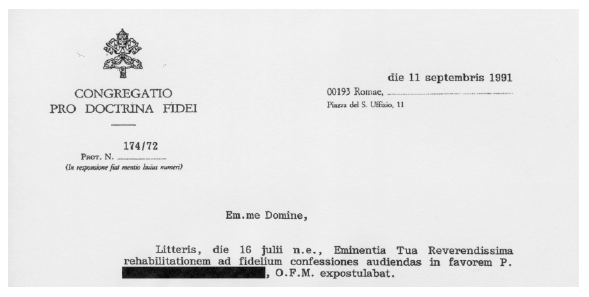
For some perpetrators, punishments were later rescinded: CORRECTIV has knowledge of two documents in which Cardinal Ratzinger exonerated abusers. One case from Portugal is the earliest in the collection. It was made available exclusively to CORRECTIV and the newspaper Observador. A Franciscan monk who abused a girl in 1956 was reported to Rome in 1972. Though this letter is missing, Ratzinger’s correspondence from 1991 is titled with the protocol number 174/72. In this letter, he partially lifted the man’s ban on hearing confession after 20 years.
Protocol numbers are essential for maintaining order in archives. At the Congregation for the Doctrine of the Faith, they consist of a case number and the year, for example: 174/72.
That means that this case was first opened with the Dicastery in the year 1972. In that year, it was the 174th case involving offenses committed by priests or matters of faith. Generally, every document which pertains to a case, regardless of the year it is created, is classified with the same protocol number so that all documents can be archived together. Sometime later, the system was expanded: in addition to the protocol number/year, a sequential number is appended after a hyphen. This number is unique for each document that is sent or received by the Congregation for the Doctrine of the Faith, and is added independently of the case it pertains to.
In some cases, Ratzinger also imposed punishments – some offenders were defrocked or excommunicated. However, one perpetrator in Germany who Ratzinger excommunicated was readmitted to the church about three years later. The man, who was known to have abused minors, was able to work without restriction in a new diocese.
The documents make the Church leadership’s true intention clear: protect the institution, avoid scandals. Two separate letters state that knowledge of these acts could “shock the community of believers.” The “good of the Church as a whole,” as Ratzinger puts it in his reply to Oakland, is evidently more important than that of its youngest members.
The law of the Church, also known as canon law, is primarily codified in the Codex Iuris Canonici (Code of Canon Law, or CIC). The law has also been expanded by papal decrees and various other decrees. Unlike state laws, justice under canonical law is shaped by theology. The most severe penalties are excommunication – that is, exclusion from the Church community, which is revocable – and dismissal from the clergy, or priesthood, which is permanent.
Even today, sexual abuse of children is not recognised by the Church as a violation of their physical integrity or their spiritual wellbeing. Instead, priests are seen to commit a violation of the sixth commandment, which states: “You shall not commit adultery.” Upon ordination, priests enter into a covenant with God and are expected to live a life of sexual abstinence, which means that sexual abuse constitutes a breach of celibacy.
Chapter 2
The Vatican’s
secret cabinet
All abuse cases by priests are usually kept in confidential archives, explains Monsignor Marzotto, who had been so surprised by one of the letters. He served as undersecretary of the Congregation for the Doctrine of the Faith under Cardinal Ratzinger. When further asked, he points to a filing cabinet: “Armadi” – Cabinets – he says.
Church historian Hubert Wolf of the University of Münster frequently goes in and out of the Vatican archives. He is also aware of the existence of the Fonti Riservate, which contains cases involving priests. And Ratzinger in a 1998 interview said himself that there was a “special vault” containing records of offenses committed by priests that with offenses by priests that “also must not be made public.” Although the historical sections of the Vatican archives are gradually being opened up to researchers, these cabinets remain locked.
According to various sources, some files are also said to be kept in the archives of the Secretariat of State, which is a combination of the cabinet office and the foreign ministry. Exactly how many documents are kept in the Vatican archives is impossible to say.
This culture of secrecy ensured that crimes against children could continue for decades. It was initially enabled by bishops, who either failed to report perpetrators to Rome at all or did so only years later, and who negotiated non-disclosure agreements with the victims. Later, Vatican officials such as Cardinal Ratzinger tightened the non-disclosure obligation in 2001, which was only lifted in 2019 by Pope Francis. Under public pressure in recent years, the Church leadership, also under Francis, amended parts of the law. Bishops now face penalties including dismissal if they fail to report cases, and prevention measures have been improved. But the people who were abused still fall through the cracks of canonical law. A transparent examination of the Vatican’s responsibility continues to be denied to this day.
According to Charles Scicluna, a former close associate of Ratzinger and now Deputy Secretary of the agency, there were 2,100 cases processed by the office between 2001 and 2010 alone. Behind every case lies the suffering of one or many individuals. A 2023 study of the population of France found 216,000 people who were abused by members of the clergy. Expanding to include those abused by laypeople in Catholic settings, the number rises to about 330,000. In the USA, Terence McKiernan of Bishop Accountability estimates the number of potential victims at about 250,000. Worldwide, the figure is likely to be several million.
CORRECTIV erzählt die Geschichte eines organisierten Verbrechens im Vatikan in mehreren Formaten: Als Buch, als Kinofilm, auf der Theaterbühne und als Recherche.
“Burn all material immediately”
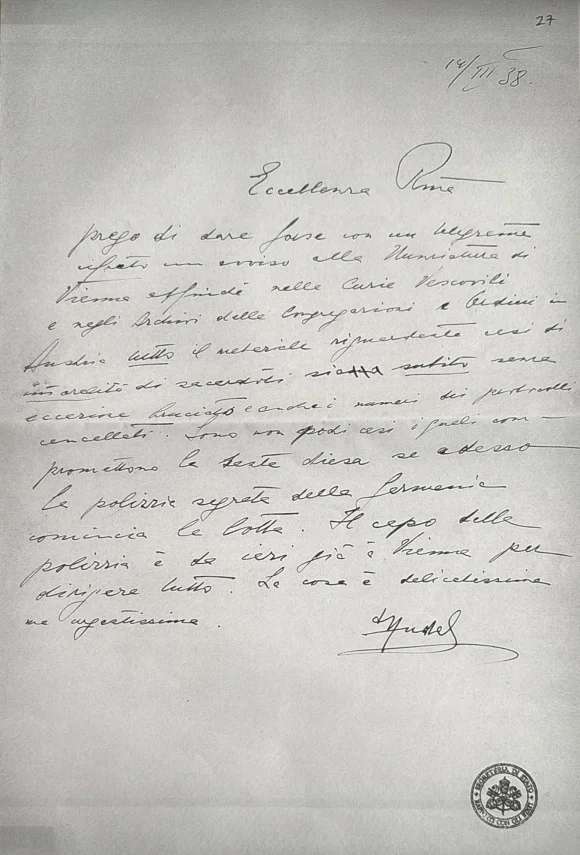
The Vatican not only established a secret archive for abuse files, it also ordered the destruction of sensitive documents. In a directive sent from the Vatican to Vienna in 1938, shortly after Hitler’s invasion of Austria, files regarding the sexual abuse of children were ordered to be burned, apparently out of fear that the material might fall into the hands of the Nazis. The handwritten decree never left Rome – it was shown to the messenger, who then delivered the message to Austria. Notably, the directive bears no protocol number. Prompted by the CORRECTIV investigation, these documents were analyzed by historian Davide Jabes (Read an exclusive analysis of the discovery here.)
Since the Roman Curia is one of the oldest institutions in the world, one could say that the Vatican archives hold “the memory of humanity”, says canonical lawyer Thomas Schüller of Münster. Many of the political and ecclesiastical developments of the past centuries are known because the “Vatican has always preserved these records in an optimal, almost exemplary manner.”
But even the memory of humanity seems to have gaps. Among other things, these occur when documents seem never to have been created, were falsely classified, or were destroyed at the local level. Beyond the burning of documents in Austria in 1938, dioceses today are subject to retention periods, after which they are no longer required to keep certain records.
Joseph Ratzinger’s papers are also no longer complete. In a 2023 interview, his former private secretary, Georg Gänswein, said that he had handed over some documents to the Vatican’s Central Archives and the Congregation for the Doctrine of the Faith – and he shredded private correspondences. In response to repeated inquiries from CORRECTIV, Gänswein stated that he would not answer any questions.
Chapter 3
The letter that
shouldn’t exist
And then there’s the letter that no one can explain. That even stumped the under secretary Monsignor Marzotto. The documents gathered by CORRECTIV all contain a protocol number, and can therefore be traced back to the Vatican archive. All, except for the handwritten order from the 1930s to burn the files, and one letter from Joseph Ratzinger regarding the priest Peter H. A case involving Ratzinger’s former archdiocese, no less.
It’s one of Germany’s most well known cases, which has been reported about repeatedly. His story must also be told here. His case illustrates more clearly than any other how the secrecy surrounding these documents is precisely what confined public debates to the regional level – and how the Vatican’s responsibility went unrecognized. This case has followed Ratzinger through every major stage of his career: he first encountered it as Archbishop of Munich and Freising. Shortly thereafter, again in the Congregation for the Doctrine of the Faith. As Pope and Pope Emeritus, the debate over his responsibility catches up with him once more.
The case that haunted the former Pope
In a meeting in Munich in 1980, two years before Joseph Ratzinger moved to Rome, a decision was made to admit the priest Peter H. from Essen. He was accused of abusing children in Essen and Bottrop, and he should be sent to Munich for therapy. But the therapy showed no results: in the summer of 1986, H. was sentenced by a judge to pay a fine and serve probation for multiple cases of child abuse. The judge imposed no restrictions on his ability to work with children and youth, even though he was a certifiably diagnosed pedophile. All of this was known to the archdiocese. Nevertheless, the leadership chose to reinstate the priest.
H.’s psychiatrist forbade him to drink, even while giving Mass, as he often drank when he abused children. The archdiocese sent a request to Rome to allow the priest to give Mass without wine. The Vatican gave the exception, signed by Cardinal Ratzinger. Even though the letter from the archdiocese mentioned the priest’s sentence and was accompanied by the certificate of his diagnosis as a pedophile, the special permission made no mention of the abuse. Peter H. was allowed to continue working, to continue taking care of children. His reinstatement was not without consequences: Peter H. went on to abuse multiple children in the next congregation.
One of whom is Andrea Perr. He was about 11 years old when he was abused by H. in the Upper Bavarian municipality of Garching an der Alz. The trauma of one evening permanently ruined his life, and today he is in jail on drug charges. But his abuser walks free and can no longer be prosecuted. Perr sued the Archdiocese of Munich and Freising – and the late Pope Benedict – for compensation for pain and suffering. In the 2,000 years of Church history, no pope has ever been made to stand before a secular judge. The case is still not closed.
Even in his current role as Pope Emeritus, Ratzinger can’t shake the case. Even before his resignation from the papacy he was confronted by it once again. In 2010, the H. case came to public attention, and the international media questioned the Pope’s involvement with the abuser. The issue resurfaced in with a report published in 2022, which aimed to review the archdiocese’s handling of sex offenders. But in both years, the debate was limited to Ratzinger’s role as archbishop – the grape juice exception remained secret from the public.
The report does address the Peter H. case, but it does not go into detail about the correspondence with the Vatican – or the fact that Ratzinger himself signed the letter. One expert, Martin Pusch, explains that they “deliberately limited themselves to the role of Cardinal Joseph Ratzinger in his capacity as archbishop.” Pusch assumes, however, that “corresponding files on such cases are available at the Congregation for the Doctrine of the Faith.” A year later, CORRECTIV received the document. It is now clear that Ratzinger’s responsibility did not end at the gates of Rome.
After CORRECTIV published the letter, a close advisor to Benedict XVI characterised it as the result of routine proceedings at the Vatican. Ratzinger often signed letters without reviewing them in detail. But his explanation is contradicted by the letter itself: the missing protocol number shows that this was no routine handling.
In response to an inquiry from CORRECTIV, the Archdiocese of Munich and Freising stated that questions regarding the Vatican’s record-keeping—including the protocol number—could only be answered by the Vatican itself. For all other questions, it refers to the 2022 report. One of Ratzinger’s former private secretaries, Josef Clemens, declined to answer any questions, citing his oath of office. He worked for Cardinal Ratzinger at the time the grape juice letter was written.
Canonical law expert Schüller points out that Ratzinger was “a prefect who worked very carefully and precisely,” and that he “took very careful note of these matters, especially when they originated in German-speaking countries. He didn’t just sign things blindly.” The Cardinal’s former private secretary, Bruno Fink, confirms: “Ratzinger always read everything, of that I am certain.”
But none of the experts understand why this letter is missing a protocol number. A letter without a number should not exist. “To be honest, I cannot explain this in a letter from the Prefect of the Congregation for the Doctrine of the Faith to a cardinal,” says historian Wolf. The former priest and canonical law expert Patrick Wall states, “The missing number could have various causes, it could be slip-up. But under Razinger, slip-ups didn’t happen.” He is certain: “the missing number in the case of Peter H. is not a mistake.”
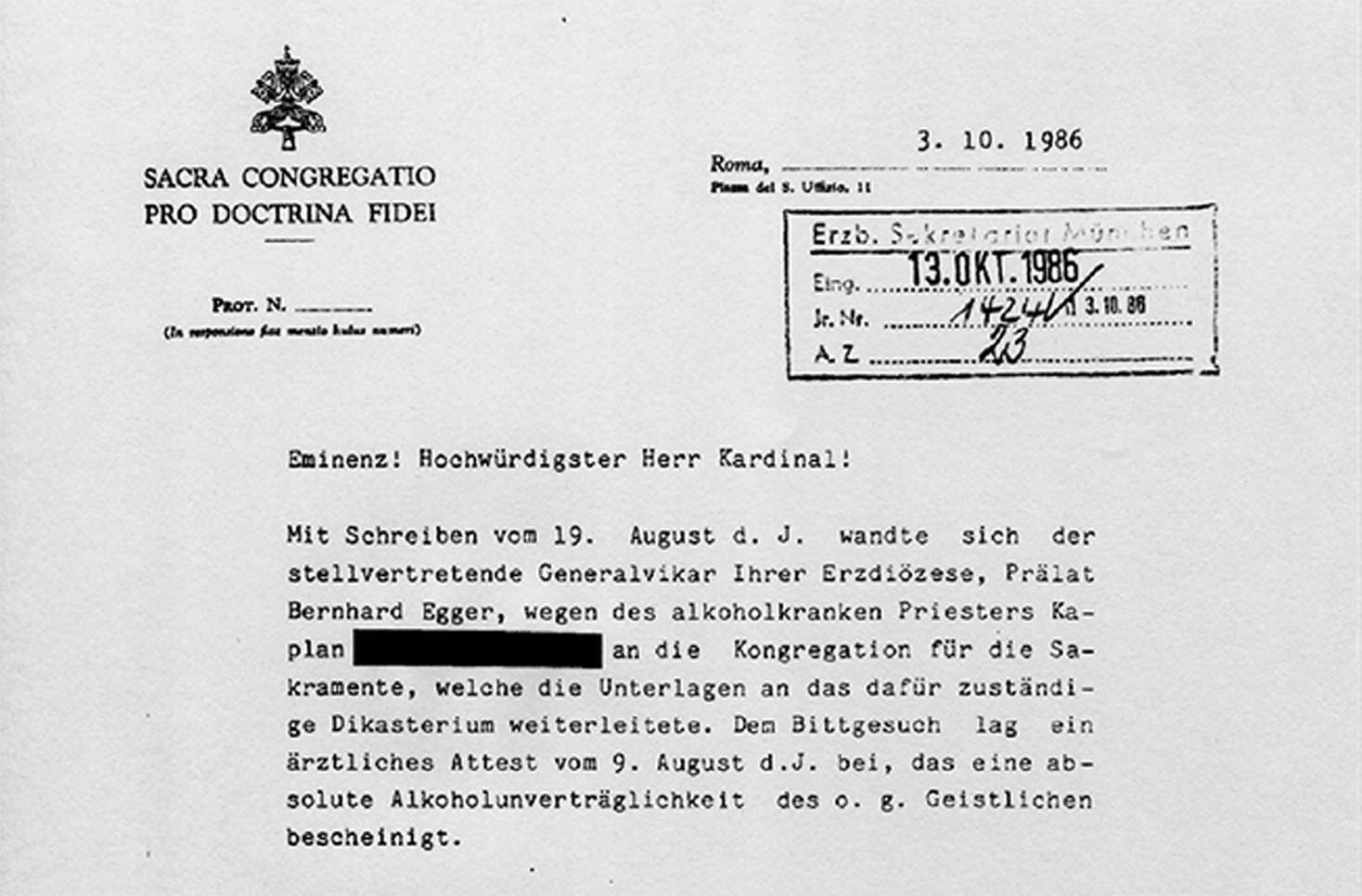
The missing number poses a decisive question, according to canonical lawyer Schüller: “did it ever make it into the archives?” At CORRECTIV’s request, a contact at the Vatican is reviewing the case and has apparently found documents dating back to 2010. In the year the case became public, Peter H. was also reported to the Congregation for the Doctrine of the Faith for abuse – no longer simply for alcohol problems. The agency assigned a case number: 163/2010. Normally, the previous number would have been reused. This is strong evidence that a number was in fact never assigned in 1986, confirms Schüller. Whether it lies hidden in one of the secret filing cabinets or was shredded before it made it there remains unclear. Despite all the new information, the grape juice letter remains a mystery. Another gap in memory.
The full scale was known
In the debate over whether Cardinal Ratzinger took sufficient action against perpetrators of abuse, his supporters repeatedly tell the same story: back when he was head of the agency in Rome, the case of Marcial Maciel Degollado landed on his desk. The founder of the “Legionaries of Christ” had recruited a number of young priests through his organization and brought in a great deal of money for the Catholic Church. High-ranking members of the Curia benefited from his network, and he enjoyed the personal favor of John Paul II. The fact he had been abusing these same young priests for decades was known in the Vatican since the 1940s and 1970s. Some of them began contacting the Vatican directly in 1997. But Maciel’s influence was too powerful, and Cardinal Ratzinger had to drop the investigation against him. Shortly after Ratzinger was elected pope, he instructed his former agency to finally punish Maciel. The 85-year-old was ordered to spend his twilight years in “penance and prayer.” According to the legend, Ratzinger was powerless until the death of John Paul II, but once Maciel was no longer protected he took decisive action.
Maciel was undoubtedly influential, but Cardinal Ratzinger could very well have intervened in other cases involving perpetrators who were unknown outside their communities: in Oakland, in Portugal, in the case of Peter H., and in many other cases.
The findings of this investigation show that the standard excuses offered by Church leadership cannot possibly be true. Given that the filing cabinet is full of material, the scale of the problem must have always been known; informed decisions were made about the perpetrators. It was also not a regional problem, as the bishops and Vatican officials claimed when the scandal broke. “Why should I wear American shoes if they don’t fit me?” boasted the former Bishop of Mainz, Karl Lehmann. The German documents from the 1930s – and all other documents revealing perpetrators from around the world – are evidence that the shoe fits. Individual cases are improbable, given that a single agency was responsible as early as 1922, a fact confirmed in 2001.
Charles Scicluna, the deputy secretary of said agency, stated in an interview that between 1975 and 1985, “not a single report of cases of pedophilia among clergy” had been sent to the Congregation for the Doctrine of the Faith. However, it was precisely during this period – in 1981 – that the agency received a request from the Bishop of Oakland to remove a priest from the clergy due to his “questionable relationships with young children.”
How many protocol numbers were never assigned, only he knows.
Chapter 4
The key to
enlightenment
Several experts report that the Pope was also aware of the issues discussed in the Congregation for the Doctrine of the Faith: The prefect and the Pope met every week, and the Pope had the final say on dismissals from the clerical state.
The new pope, Leo XIV, has not responded to questions from CORRECTIV. He initially referred the matter to the Pontifical Commission for the Protection of Minors, and the inquiry was also assigned a protocol number: 404/2025. The commission does not see itself in the position to comment on the matter. Two more letters to the Pope and several attempts to speak with him at his summer residence in Castel Gandolfo yielded no answers. After 20 inquiries, the Congregation for the Doctrine of the Faith also remains stubbornly silent.
Whenever the issue returns to the spotlight, cardinals and popes are quick to publicly express regret for the terrible things that were done to the victims. But the letters make it clear that their primary concern is to protect their reputation.
Thomas Doyle, canonical lawyer and former staff member at the Vatican Embassy in the United States, recalls that, during his time in the 1970s and 1980s, many high-ranking officials were aware of sexual abuse by priests and even discussed it with members of the Curia. As he describes it, it sounds as though there was a “circle of insiders.”
The agency’s own deputy secretary Scicluna said in 2012 that the Church was dominated by a “deadly culture of silence, or omertà, which is in itself wrong and unjust.” Omertà is the Mafia’s code of silence. He admits that Church officials saw the institution’s good reputation as more important than addressing the crimes. Scicluna has also not responded to inquiries.
The letters uncovered by this investigation offer a peek into the secret archive. They give a sense of what could be revealed, if access to the whole archive would be granted: “The Catholic Church is so methodical and so well-organized, little samples of this huge library allow us to reconstruct the whole picture” said Terence McKiernan from Bishop Accountability.
Church historian Wolf is calling on the Catholic Church to make all files related to abuse publicly available: “I would like to see all Roman sources from 1900 to 2025 kept by the Secretariat of State, and especially by the Congregation for the Doctrine of the Faith.” He wants to get a clear picture of who – from low-level staff to the Pope – knew about this and how decisions were made. Attorney Martin Pusch, who contributed to the expert report on the archdiocese, also advocates for an international, interdisciplinary commission to review the material.
Haben Sie Hinweise?
Wir möchten Korrespondenzen mit dem Vatikan zum Thema sexueller Missbrauch aufdecken und brauchen Ihre Hilfe. Haben Sie Dokumente, die Sie anonym und sicher mit uns teilen können?
Walter Robinson at the Boston Globe says, “The Church’s biggest problem is still a lack of transparency. They don’t understand that the Church needs to have a full and complete confession before people will be willing to trust again.” He doubts that the Church will agree to the public disclosure of all documents – “and I don’t know if they would survive it.”
Italian journalist Federica Tourn has been investigating cases of abuse for years is convinced: “If the Church truly showed transparency regarding sexual abuse, the whole thing would collapse.” Because “the Church is built on a structure of silence.”
Terence McKiernan, the archivist from the USA, questions who has claim over these documents. “Who do these documents belong to? Do they really belong to the managers who have not only allowed this abuse to happen but facilitated it in many cases? Do they really belong to the people who were abused as children?”
Jennifer Stein, a lawyer from the USA who has represented multiple victims of assault in Oakland, has no doubt that access to the records would help those affected because people would finally believe them. “If the Catholic Church wanted to, they could put their words into action. They could refrain from hiding their secrets and make transparent every fact and every morsel of information that they know.”
When the Boston Globe uncovered the abuses in 2002, an adviser to the cardinals of Boston told journalist Walter Robinson, “you’re in this for a year or more, the Church is in this for centuries. And they think that they can weather this storm.“ Today, Robinson says, “I still think that they believe that.”
Canonical law expert Patrick Wall says, “crimes of child sexual abuse and systematic cover-ups are part of the DNA of the Roman Catholic Church.” Because it is effectively structured like a monarchy, he is convinced: “The pope’s role is to preserve unity. For this reason, nothing will change.”
The answers lie in the Armadi, the cabinets at the Vatican.
469/81s. | Oakland, Kalifornien/USA
- 1981: Request for dismissal from the clergy by the Bishop of Oakland
- 1985: After repeated inquiries, Cardinal Ratzinger responds: Despite all the good reasons to dismiss the man, the dicastery needs more time to decide. The priest’s young age must be taken into account; dismissing him now could harm the good of the whole Church.
- 1987: One day before his 40th birthday, he was defrocked
- According to experts, it was customary at the time not to defrock priests under the age of 40. There was a shortage of priests, and the Church leadership under John Paul II hoped that issues such as a desire to marry or sexual misconduct would resolve themselves with maturity.
11/96-06996 | Wisconsin, Milwaukee/USA
- July 1996: Bishop Rembert G. Weakland reports two abusers to the Congregation for the Doctrine of the Faith
- One of the priests had abused approximately 200 children at a school for the deaf
- March 1997: Due to the lack of a response, the bishop writes to the highest Vatican court, the Apostolic Signatura
- March & April 1997: Responses from the Congregation (Secretary Tarcisio Bertone) and the Apostolic Signatura overlap. The Congregation has jurisdiction, the bishop is permitted to proceed under the 1962 decree, and criminal proceedings are initiated with the aim of removing him from the clergy.
- January 1998: The priest attempts to challenge the proceedings before the Dicastery
- April 1998: The Dicastery halts the proceedings and requests that other legal avenues be pursued
- After a meeting in May 1998, the bishops decide to terminate the existing criminal proceedings and initiate administrative proceedings
- August 21, 1998: Death of the priest
174/72 | Lisbon, Portugal
- 1956: Abuse of a girl
- 1972: Report to the Congregation for the Doctrine of the Faith, followed by a ban on hearing confessions
- 1991: Cardinal Ratzinger partially lifts the ban on hearing confessions
70/89s. | 1989 Springfield, Illinois/USA
- 1985: A priest from Springfield is sentenced to 14 years in prison for sexual abuse; the case is reported in the media
- February 1989: The Bishop of Springfield asks the Dicastery for help, the priest refuses to request dismissal from the clerical state himself
- July 1989: Response from the Dicastery via Cardinal Ratzinger: As long as the priest does not request it himself, the Dicastery cannot take action; reference to penal norms in the CIC
305/2003-31697 | Savona, Italien
- 2003: A bishop reports a priest from Savona to the Dicastery
- April 2006: Meeting between the bishop and Scicluna in Rome
- April 2006: The Dicastery decides that the priest should request dismissal from the clergy, otherwise the diocese will initiate legal proceedings
- Around 2009, the victim, Francesco Zanardi, reports the matter to the diocese and files a complaint against the priest
- March 2010: Secretary of the Dicastery Ladaria requests an update
- Two days earlier, the priest requested his dismissal, presumably at the new bishop’s request
578/2004-32056 | Pereira, Colombia
- 2002: First allegations against a priest
- 2004: The Bishop of Pereira reports the priest to the Dicastery
- 2006: The Dicastery apparently orders an administrative investigation
- 2010: The public prosecutor’s office initiates proceedings following new allegations
- 2010: Undersecretary Damiano Marzotto Caotorta inquires about the current status
- The bishop initially responds that the case has been resolved, but then admits that the priest was sentenced to prison
- 2014: Death of the priest
Credits
- Text und Research: Anna Kassin, Marcus Bensmann
- Editorial supervision: Justus von Daniels
- Editing: Frida Thurm
- Fact checking: Finn Schöneck
- Final editing: Katarina Huth
- Video: Cem Bozdogan, Lennard Birmanns, Kolja Zinngrebe, Philipp Schulte
- Contribution: Cem Bozdogan, Christina Badde, Kolja Zinngrebe, Lennard Birmanns, Finn Schöneck, Leon Ueberall, Sarah Bayerschmidt, Bjarne Overkott
- In collaboration with: Walter V. Robinson (Boston Globe), João Gomes (Observador), Juan Barrientos (Casa Macondo), Miguel Estupiñán (HaciaElUmbral), Íñigo Domínguez (El País)
- Design: Mohamed Anwar, Maximilian Bornmann, Philipp Waack, Hans Spieß, Ahmed Farghali
- English version: Sara Cooper
- Published on: March 19, 2026